
The Fear of Magadha Under King Dhanananda – A Kingdom Ruled by Fear (Part 2)
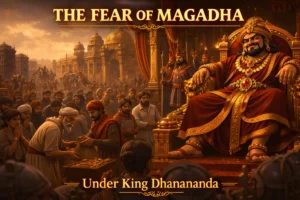
📖 The Fear of Magadha Under King Dhanananda
Ancient India witnessed the rise and fall of many powerful kingdoms. Among them, Magadha stood as one of the richest and most influential empires of its time.
Its fertile lands produced abundant crops.
Its rivers supported trade and agriculture.
Its markets were filled with merchants, craftsmen, and travelers from distant regions.
At the center of this powerful kingdom ruled King Dhanananda, the final ruler of the Nanda dynasty.
Despite the wealth and strength of the kingdom, this period became widely remembered as The Fear of Magadha Under King Dhanananda.
From the outside, Magadha appeared powerful and prosperous. But within its cities and villages, a quiet atmosphere of fear had begun to spread.
The people respected the king — but not out of loyalty.
They respected him out of fear.
The Rise of a Powerful Kingdom
Before understanding The Fear of Magadha Under King Dhanananda, it is important to understand how powerful the kingdom had become.
Magadha had been expanding for generations. Previous rulers had strengthened its administration, developed agriculture, and expanded trade networks.
This success created enormous wealth.
The royal treasury was said to contain huge amounts of gold, silver, and precious stones.
Magadha also possessed one of the most powerful armies in ancient India.
Its forces included:
- Thousands of trained soldiers
- Powerful war elephants
- Skilled cavalry
- Large numbers of chariots
This military strength made Magadha appear nearly invincible.
But power without wisdom can become dangerous.
And under King Dhanananda, that danger slowly became reality.
Rule of Fear
The period known as The Fear of Magadha Under King Dhanananda was defined by strict and often harsh governance.
King Dhanananda believed that strong authority required strict control.
He relied heavily on wealth and military power rather than public trust.
To maintain control over the kingdom, spies were placed throughout towns and villages.
These informants were tasked with reporting even the smallest signs of criticism against the king.
Because of this system, ordinary people became extremely cautious.
Conversations stopped when royal officers approached.
Neighbors avoided discussing political matters.
Fear replaced open communication.
The royal palace remained grand and luxurious, filled with gold and decorations.
But outside the palace walls, the atmosphere was very different.
The kingdom was slowly becoming a place where obedience was demanded rather than earned.
Heavy Taxation and Economic Pressure
One of the main reasons behind The Fear of Magadha Under King Dhanananda was the burden of taxation.
The royal treasury was famous for its enormous wealth.
But that wealth came from heavy taxation imposed on the people.
Farmers were required to surrender a large portion of their harvest as tax.
For agricultural families, this meant losing much of the food they worked hard to produce.
Merchants and traders also faced high duties on goods transported between cities.
Craftsmen, artisans, and small business owners struggled under these financial pressures.
The king believed that maintaining a rich treasury would ensure the strength of the kingdom.
But for the people, this policy created hardship.
Many farmers had barely enough grain left to support their families.
Small traders found it difficult to continue their businesses.
While the palace grew richer, many villages became poorer.
This imbalance slowly increased dissatisfaction among the population.
Misuse of Military Power
Another major factor behind The Fear of Magadha Under King Dhanananda was the misuse of military power.
Magadha possessed one of the largest armies of the time.
Such military strength should have been used to protect the kingdom from external threats.
However, the army was often used to suppress internal dissent.
Whenever villagers protested unfair taxation or questioned government policies, soldiers were quickly sent to maintain order.
The sight of armed forces entering a village created an atmosphere of intimidation.
Instead of feeling protected, many people felt threatened.
The army, which should have been a symbol of security, became a reminder of the king’s authority.
This further increased the fear within the kingdom.
The Growing Dissatisfaction
Although Magadha appeared strong from the outside, dissatisfaction was slowly growing within its borders.
Heavy taxes, strict control, and fear-based governance created resentment among many citizens.
People began quietly questioning the fairness of the system.
But speaking openly remained dangerous.
Fear controlled daily life.
And this is why historians remember this period as The Fear of Magadha Under King Dhanananda.
Kingdoms built on fear often appear powerful for a time.
But beneath the surface, instability begins to grow.
A Watchful Observer
Among those who observed the situation carefully was a brilliant scholar named Chanakya.
Chanakya was a teacher and strategist known for his deep understanding of politics and governance.
He believed that a kingdom should be governed through wisdom, discipline, and fairness.
According to his principles, rulers should strengthen the prosperity of the people rather than exploit them.
As he studied the conditions in Magadha, Chanakya recognized a dangerous pattern.
A kingdom ruled through fear may appear strong.
But such a system eventually becomes unstable.
This realization would later influence the decisions that changed the course of Indian history.
The Fragile Foundation of Fear
The story of The Fear of Magadha Under King Dhanananda teaches an important lesson.
Fear can maintain control for a short period.
But it cannot build lasting stability.
A kingdom built on fear lacks trust.
Without trust, loyalty disappears.
Without loyalty, even the strongest armies cannot protect a ruler forever.
Although King Dhanananda believed his power was secure, history was quietly preparing a dramatic transformation.
A strategist was observing the flaws of the system.
And somewhere else, a young boy named Chandragupta Maurya was growing up under difficult circumstances.
Soon, their paths would cross.
And when they did, the foundations of Magadha would be shaken.
🌟 Moral: The Fear of Magadha Under King Dhanananda
Power maintained through fear may create temporary control, but true stability comes from justice and trust.
❓ Frequently Asked Questions about The Fear of Magadha Under King Dhanananda
1. Who was King Dhanananda?
King Dhanananda was the last ruler of the Nanda dynasty and one of the wealthiest kings of ancient India.
2. Why was Magadha feared during Dhanananda’s rule?
Magadha became feared because of heavy taxation, strict surveillance through spies, and the use of military force to suppress dissent.
3. Was Magadha a powerful kingdom?
Yes, Magadha was one of the richest and most powerful kingdoms of ancient India with a large army and strong economy.
4. Who opposed the rule of Dhanananda?
The strategist Chanakya later opposed Dhanananda and helped establish a new empire.
5. Who eventually replaced the Nanda dynasty?
Chandragupta Maurya later overthrew the Nanda dynasty and founded the Maurya Empire.
📖 Continue the Chanakya Series
⬅ Part 1: Who Was King Dhanananda of Magadha?
➡ Part 3: Who Was Chanakya Before Magadha?
- The Lonely Elephant and His New Friends – A Heartwarming Friendship Story with 7 Powerful Life Lessons

- The Fox and the Stork Story in english with moral – 7 Powerful Lessons About Kindness, Trickery, and Respect
- The Clever Monkey and the Greedy Crocodile Story – 7 Brilliant Lessons on Intelligence and Trust
- The Tortoise and the Hare Story with Moral | A Timeless Tale of Patience and Success
- The Sun and the Wind Story – A Timeless Moral Story for Children and Adults
- 🐦 Thirsty Crow Story in English for Kids 🌿 | Short Moral Story with Life & Money Lessons







📣 YouTube Channel Subscribe Line
👉 Subscribe to our YouTube channel for more beautiful moral stories for kids!
🔗 YouTube Channel – A Moral Stories (English)















Post Comment