Tenali Solved the Problem in Silence :
The royal court of Vijayanagara was restless.
Scholars from distant lands had gathered.
Each claimed unmatched knowledge.
At the center sat King Krishnadevaraya, listening patiently.
A problem had been announced.
“If anyone solves this,” the king said,
“they will be rewarded generously.”
The scholars rushed forward.
They debated loudly.
They argued endlessly.
They quoted books and scriptures.
Hours passed.
No solution.
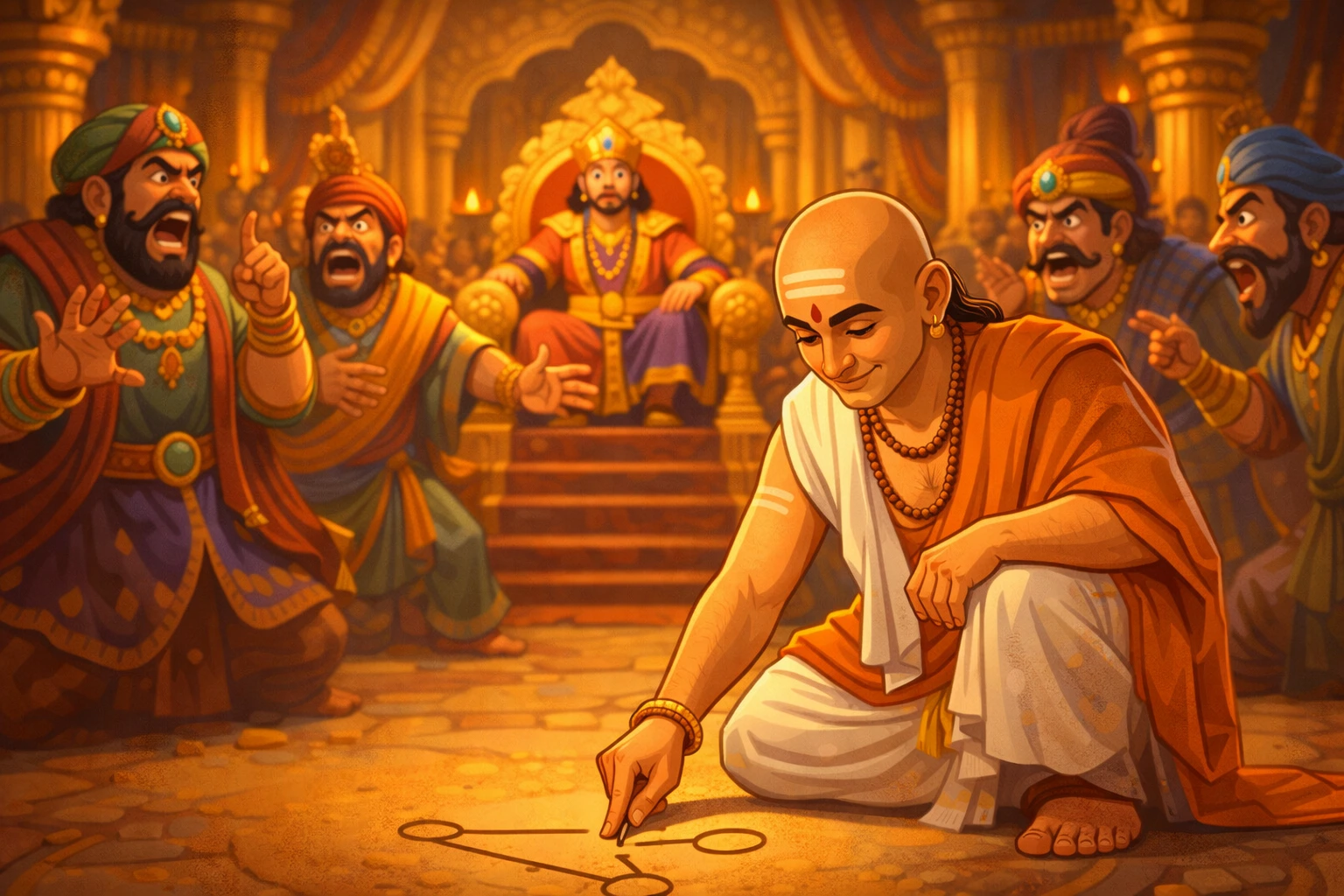
At the corner of the hall stood Tenali Raman, silent.
A scholar noticed him and laughed.
“Why does he not speak?”
“Does silence mean ignorance?”
Tenali smiled faintly.
The king observed carefully.
The problem was simple in appearance,
yet confusing in logic.
Tenali stepped forward quietly.
He did not argue.
He did not explain.
Instead, he picked up a small chalk piece.
On the floor,
he drew a simple diagram.
No words.
Just clarity.
The court leaned forward.
The scholars fell silent.
In a few strokes,
the answer became obvious.
The king stood up.
“So simple,” he said.
“Yet none of you saw it.”
The scholars felt embarrassed.
Tenali bowed respectfully.
The king smiled.
“Tenali,” he said,
“today you proved something important.”
He addressed the court:
“Noise hides understanding.
Silence reveals it.”
Tenali returned to his place
without a single word spoken.
That day,
the court learned—
True wisdom does not compete for attention.
It waits for the right moment
and speaks only when needed.
🌟 MORAL OF THE STORY
Intelligence does not need loud words.
Clarity often arrives in silence.
💙 You May Also Like :
The King Waited for a Gift He Couldn’t See… Tenali Raman Never Brought One













Post Comment