
⭐ Introduction – A Lesson Hidden in Silence (The Foolish Sage and the Thieves)
Long ago, in a quiet forest village surrounded by tall trees and flowing streams, lived a sage who was known far and wide for his wisdom.
People believed he knew the secrets of life.
They believed he could see truth where others saw confusion.
They believed he could never be fooled.
But sometimes, the most dangerous mistake is believing that we are smarter than everyone else.
This is the story of The Foolish Sage and the Thieves — a story that teaches us that overconfidence can be more dangerous than ignorance.
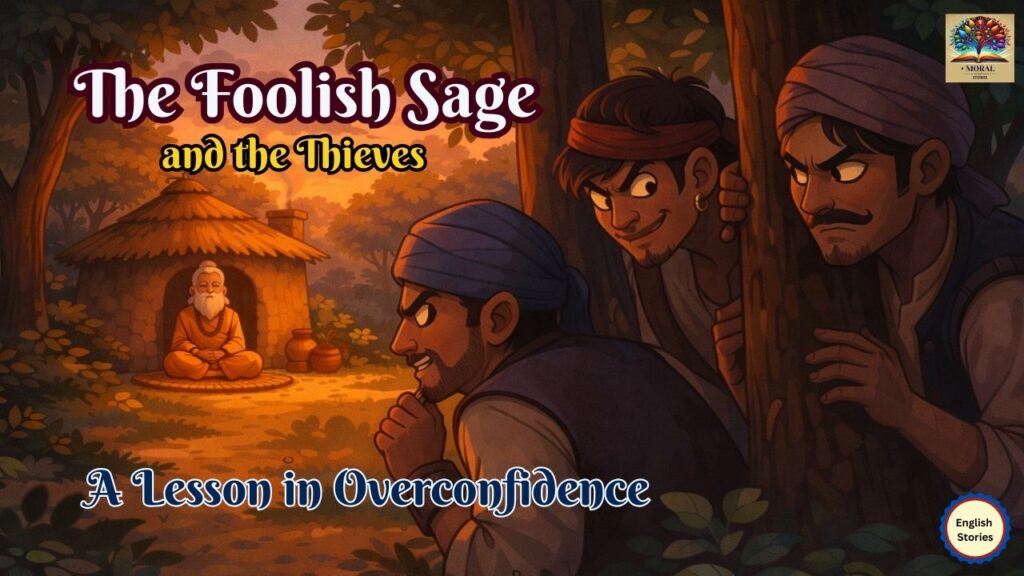
🌿 Scene 1 – The Wise Sage of the Forest
(The Foolish Sage and the Thieves)
The sage lived alone in a small hut made of mud and wood.
He wore simple clothes, ate simple food, and spoke gentle words.
Villagers often visited him for advice.
“Guruji, what is the meaning of life?”
“Guruji, how do we find peace?”
“Guruji, how do we become wise?”
The sage always answered calmly.
People respected him deeply.
They also gave him food, clothes, and sometimes money out of respect.
The sage kept all these things in a cloth bundle inside his hut.
Over time, he began to believe something dangerous:
👉 “I am wiser than everyone else.”
And when wisdom turns into pride, trouble is never far away.

🌿 Scene 2 – The Arrival of the Three Thieves
(The Foolish Sage and the Thieves)
One evening, three travelers passed through the forest.
They were not ordinary travelers.
They were thieves.
Clever. Quiet. Observant.
From a distance, they noticed the sage’s hut.
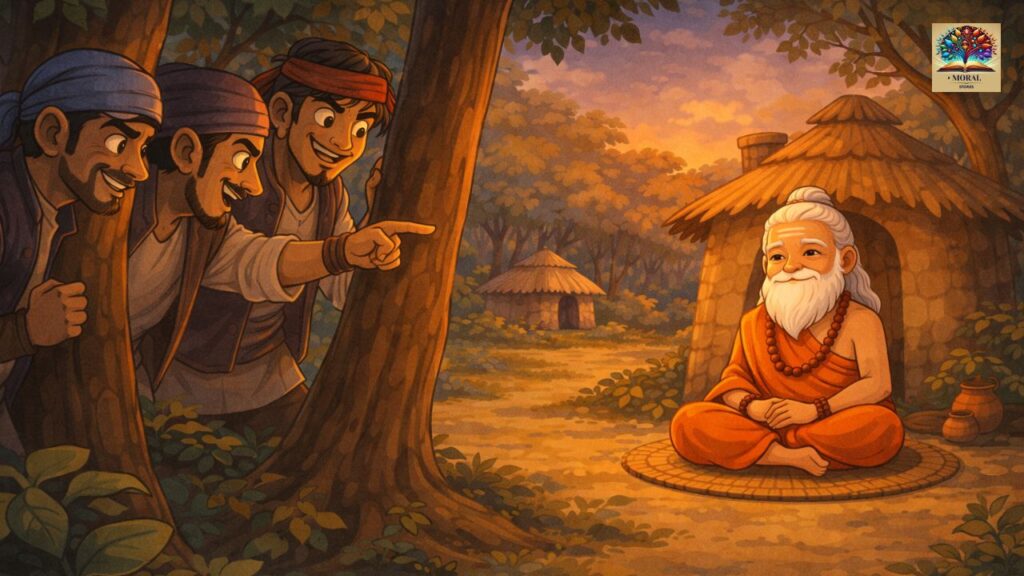
One of them whispered,
“Look at that man. People bring him gifts every day.”
Another said,
“He lives alone. Easy target.”
The third smiled and said,
“Let’s see how wise this ‘wise man’ really is.”
They decided to approach carefully.
🌿 Scene 3 – The Meeting
(The Foolish Sage and the Thieves)
The three thieves walked toward the hut as the sun began to set.
The sage saw them coming.
He looked at their faces, their eyes, their body language.
In that moment, he understood the truth.
“These men are not travelers,” he thought.
“They are thieves.”
But instead of becoming alert, the sage smiled.
Inside his mind, he said to himself:
“I know who they are. They cannot fool me. I am wiser than them.”
This thought made him feel powerful.
And this is where his mistake began.
🌿 Scene 4 – A False Welcome
(The Foolish Sage and the Thieves)
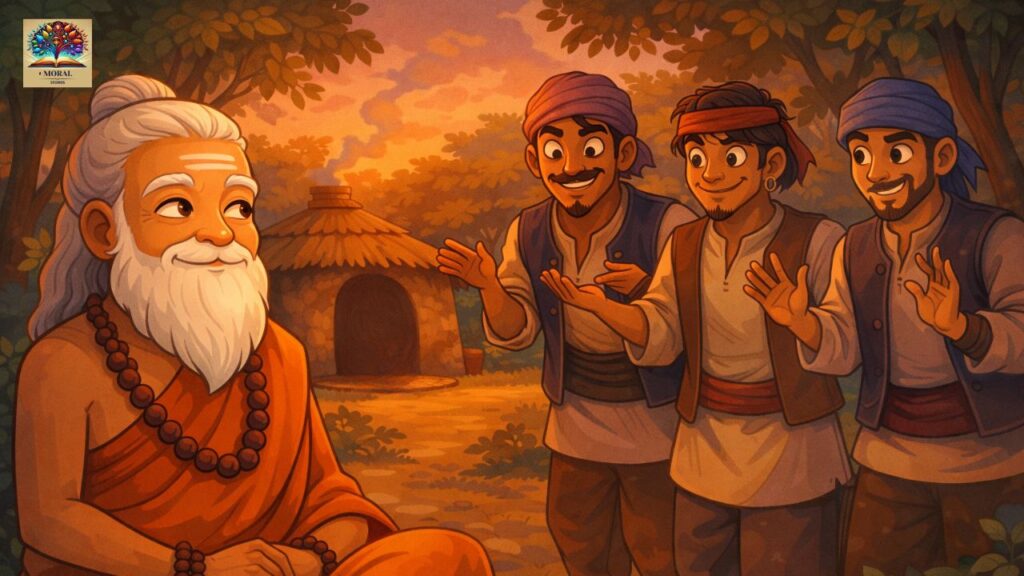
The thieves greeted the sage respectfully.
“Guruji,” one of them said, “we are tired travelers. May we rest here for the night?”
The sage nodded calmly.
“Yes, you may stay,” he replied.
Inside, he thought,
“I will watch them. They cannot trick me.”
The thieves sat quietly.
They spoke softly.
They behaved politely.
They acted like humble guests.
The sage felt proud.
“See,” he thought,
“I knew it. I am in control.”
🌿 Scene 5 – Overconfidence Grows
(The Foolish Sage and the Thieves)
As night fell, the forest became silent.
The sage lit a small lamp inside his hut.
The thieves sat quietly near the door.
After some time, the sage said,
“I am tired. I will sleep now.”
Inside his heart, he thought,
“Even if they are thieves, what can they do? I am alert. I know their nature.”
That thought—
that one thought—
was his biggest mistake.
Overconfidence had closed his eyes.
🌿 Scene 6 – When Wisdom Sleeps
(The Foolish Sage and the Thieves)
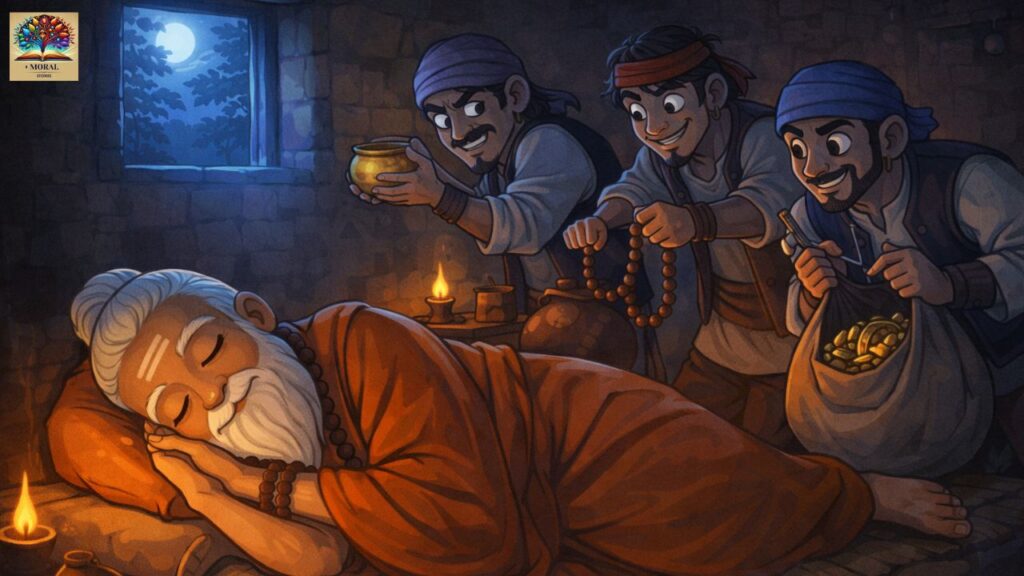
The sage lay down and slowly drifted into sleep.
His breathing became deep and slow.
The lamp flickered.
Outside, the forest was silent.
The three thieves looked at one another.
One whispered,
“He is asleep.”
Another nodded.
The third smiled.
Slowly, carefully, they stood up.
They picked up the bag of belongings.
Coins. Food. Clothes.
Everything.
Without a sound, they stepped out of the hut and disappeared into the darkness.
🌿 Scene 7 – Morning of Truth
(The Foolish Sage and the Thieves)
When the sun rose, the sage opened his eyes.
For a moment, everything felt normal.
Then he looked around.
The bag was gone.
The hut was empty.
Silence filled the space.
The sage sat up slowly.
Reality struck him like a wave.
“They fooled me…” he whispered.
He did not cry.
He did not shout.
He simply closed his eyes.
And for the first time in his life, he felt true humility.
🌿 Scene 8 – The Realization
(The Foolish Sage and the Thieves)
The sage spoke softly to himself:
“I knew they were thieves…
Yet I trusted my pride more than my wisdom.”
“My knowledge made me careless.”
“My confidence made me blind.”
That day, the sage learned a lesson greater than all his books.
He learned that wisdom without awareness is foolishness.
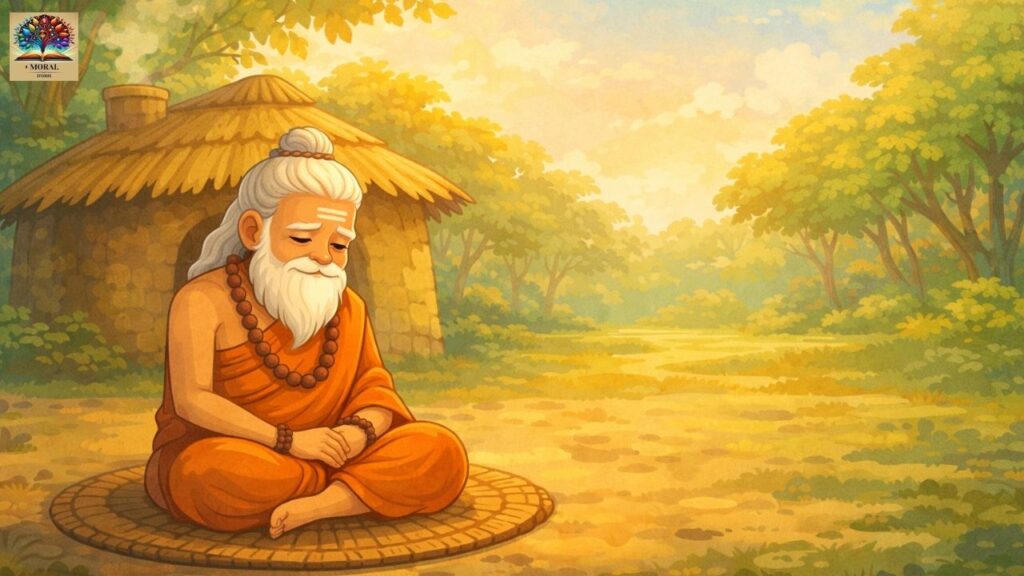
🌿 Scene 9 – Silence After the Storm
(The Foolish Sage and the Thieves)
The forest was quiet.
Too quiet.
The sage sat alone inside his hut, staring at the empty space where his belongings once lay. The morning sun entered softly through the small window, but its warmth did not comfort him.
For the first time in many years, the sage felt small.
He whispered to himself,
“I knew they were thieves… then why did I trust them?”
His voice trembled—not with anger, but with realization.
That silence around him was louder than any noise.
🌿 Scene 10 – The Weight of Realization
(The Foolish Sage and the Thieves)
The sage slowly stood up and walked outside his hut.
Birds were chirping.
Leaves were dancing in the wind.
Life was moving on.
But inside him, something had changed.
He thought deeply.
“I spent my whole life teaching wisdom to others… yet I failed to apply it myself.”
He remembered how proudly he had thought:
“I am smarter than them.”
That thought now burned inside his heart.
He understood that knowledge without awareness becomes pride, and pride blinds even the wisest minds.
🌿 Scene 11 – The Inner Dialogue
(The Foolish Sage and the Thieves)
The sage sat under a tree and spoke to himself:
“I thought knowing the truth was enough.
But wisdom is not just knowing — it is acting carefully.”
He realized something very important:
👉 Overconfidence does not protect you; it exposes you.
He remembered how calm he had felt while going to sleep, believing that nothing could happen.
That calmness had been false.
It was not peace.
It was carelessness.
🌿 Scene 12 – The Lesson Takes Shape
(The Foolish Sage and the Thieves)
As the day passed, villagers came to see the sage.
They saw his empty hut and worried faces.
One of them asked,
“Guruji, what happened?”
The sage looked at them and spoke honestly.
“I made a mistake,” he said softly.
“I knew danger was near, yet I ignored it.”
The villagers were surprised.
“But you are wise,” one said.
The sage smiled sadly.
“Wisdom is not about knowing everything.
It is about knowing when to be careful.”
🌿 Scene 13 – A New Teaching Begins
(The Foolish Sage and the Thieves)
From that day onward, the sage changed the way he taught.
Earlier, he taught about peace, meditation, and knowledge.
Now, he added something new:
“Children,” he said,
“Never think that intelligence makes you safe.”
“Never think that because you understand something, it cannot harm you.”
“True wisdom walks with awareness.”
His words touched hearts more deeply than ever before.
🌿 Scene 14 – The Story Spreads
(The Foolish Sage and the Thieves)
Slowly, people began to share the story.
They told their children:
“There was once a sage who knew everything… except when to be careful.”
They told travelers:
“Even the wise can fall if pride enters the heart.”
The story became a lesson passed from one generation to another.
Thus, The Foolish Sage and the Thieves became more than a tale —
it became a warning.
📘 More Stories :
- Heart Touching Father Son Story with Moral – A Real Story That Will Change Your Thinking About Father’s Love

- The Elephant Rope Story with Moral: A Powerful Tale About Limiting Beliefs
- A Grandfather’s Powerful Secret: The Two Wolves Story with Moral That Can Change Your Life

- Poor Student Success Story – He Studied Under a Streetlight and Proved Everyone Wrong
- The Deer Who Waited Instead of Running – A Moral Story About Patience and Wisdom
- 🧠 Why Chanakya Trusted Silence Over Strength – A Powerful Wisdom Story

🌿 Scene 15 – A Quiet Truth
(The Foolish Sage and the Thieves)
One evening, as the sun set behind the trees, the sage sat peacefully outside his hut.
He was poorer than before.
But wiser.
He smiled gently and whispered,
“I lost my belongings… but I found understanding.”
And in that moment, he was no longer a foolish sage.
He was a wise man who had learned.
🌿 Scene 16 – A Changed Man
(The Foolish Sage and the Thieves)
After that day, the sage was no longer the same person.
He still lived in the same hut.
He still wore the same simple clothes.
But inside him, something had changed forever.
He no longer believed that knowledge alone made a person wise.
Now, he believed something deeper:
“True wisdom is not knowing everything…
it is knowing when to be careful.”
Every morning, he would sit outside his hut and think quietly.
Not with pride.
Not with arrogance.
But with awareness.
The loss he suffered became his greatest teacher.
🌿 Scene 17 – Teaching the Children
(The Foolish Sage and the Thieves)
Soon, children from nearby villages began coming to the sage again.
They sat around him, curious and innocent.
One child asked,
“Guruji, is it bad to trust people?”
The sage smiled gently.
“No, my child,” he said.
“Trust is beautiful. But blind trust is dangerous.”
Another child asked,
“Then how do we know whom to trust?”
The sage replied softly,
“By watching actions, not just words.”
The children listened carefully.
For the first time, the sage was not teaching from books —
he was teaching from experience.
🌿 Scene 18 – The Real Meaning of Wisdom
(The Foolish Sage and the Thieves)
The sage told the children:
“Wisdom is not about how much you know.
Wisdom is about how carefully you use what you know.”
He explained:
- A sharp mind without awareness can be fooled.
- A kind heart without caution can be hurt.
- A strong belief without balance can become blindness.
The children nodded.
They understood that being smart is good,
but being alert is better.
🌿 Scene 19 – A Lesson for Life
(The Foolish Sage and the Thieves)
Word of the sage’s lesson spread far and wide.
People no longer remembered him as just a learned man.
They remembered him as:
The sage who learned from his mistake.
Parents told their children:
“Be kind, but be careful.”
“Trust, but verify.”
“Think before you act.”
The story of the foolish sage slowly turned into a story of wisdom.
The Two Seeds Moral Story for Kids (Hard Work vs Comfort) – Must Read for Parents & Teachers
🌿 Scene 20 – A Quiet Ending
(The Foolish Sage and the Thieves)
One evening, as the sun dipped behind the trees, the sage sat peacefully.
He was no longer proud.
He was no longer careless.
He was calm.
He smiled to himself and whispered,
“Losing my belongings taught me more than gaining knowledge ever could.”
The forest grew quiet.
The lesson remained.
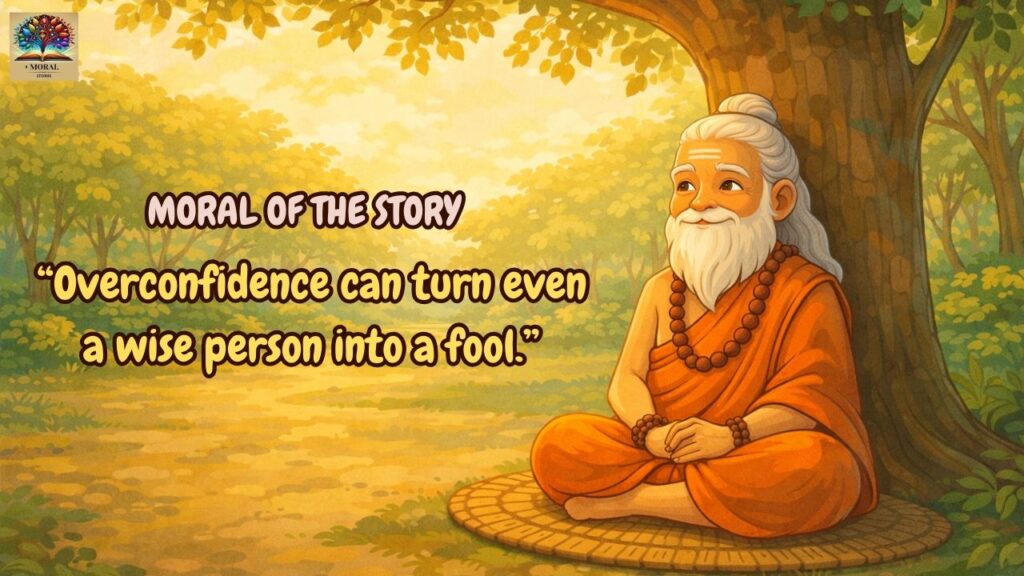
🌱 MORAL OF THE STORY
👉 Overconfidence can make even the wisest person foolish.
👉 Blind trust can lead to loss.
👉 True wisdom lies in awareness, not pride.
🌟 One-Line Moral
“Overconfidence can turn even a wise person into a fool.”
🌱 Life Lessons from The Foolish Sage and the Thieves
- Never trust blindly.
- Wisdom without awareness is dangerous.
- Overconfidence leads to mistakes.
- Being smart doesn’t mean being careless.
- Learn from mistakes, not pride.
- Always stay alert.
- Think before you act.
- Trust should be earned.
- Experience teaches better than words.
- True wisdom comes with humility.
📘 Vocabulary for Young Readers
(The Foolish Sage and the Thieves – Moral Story in English)
| Word | Meaning |
|---|---|
| Sage | A wise person |
| Thief | A person who steals |
| Trust | Believing someone |
| Overconfidence | Too much belief in oneself |
| Wisdom | Ability to make good decisions |
| Careless | Not careful |
| Alert | Being watchful |
| Deceive | To cheat or trick |
| Realize | To understand clearly |
| Lesson | Something learned from experience |
| Awareness | Being careful and thoughtful |
| Mistake | Something done wrong |
| Caution | Care to avoid danger |
| Intelligence | Ability to think and understand |
| Consequence | Result of an action |
🏡 Activities for Parents & Teachers
(Based on The Foolish Sage and the Thieves)
🎭 1. Role Play Activity
Children can act as:
- The Sage
- The Three Thieves
- The Narrator
👉 This helps children understand trust, overconfidence, and awareness.
🎨 2. Art & Drawing Time
Ask children to draw:
- The sage sitting outside his hut
- The three thieves planning
- The empty hut in the morning
👉 Builds creativity + moral understanding.
💬 3. Discussion Questions
Use these questions after reading the story:
- Why did the sage trust the thieves?
- Was the sage really wise?
- What mistake did he make?
- What should he have done instead?
- Have you ever trusted someone too quickly?
👉 Helps build thinking and emotional awareness.
✍️ 4. Creative Writing Prompt
“Imagine you are the sage. What would you do differently?”
👉 Helps children reflect and learn decision-making.
🧩 5. Moral Quiz (Fun Learning)
- Who were the visitors in the story?
- Did the sage know they were thieves?
- Why did the sage still sleep?
- What mistake did the sage make?
- What lesson did the story teach?
👉 Makes learning fun and memorable.
❓ FAQs – The Foolish Sage and the Thieves
Q1. What is The Foolish Sage and the Thieves story about?
It is about a wise man who becomes overconfident and trusts thieves, leading to his loss.
Q2. What is the moral of the story?
Blind trust and overconfidence can lead to loss.
Q3. Why is the sage called foolish?
Because he knew the men were thieves but still trusted them due to pride.
Q4. Is this story suitable for kids?
Yes, it teaches awareness, caution, and thinking before trusting.
Q5. What does the story teach children?
It teaches that intelligence must be used wisely, not proudly.
🌙 Final Thoughts – A Story That Teaches Awareness
At first, the sage thought he knew everything.
But true wisdom came only after loss.
This story reminds us that intelligence alone is not enough.
Awareness, humility, and caution are just as important.
For children, it teaches safety and thinking skills.
For parents, it reminds us to teach awareness, not fear.
Because sometimes,
the biggest danger is not others — it is our own overconfidence.
⭐ Closing Message
Thank you for reading The Foolish Sage and the Thieves.
If this story helped you think, learn, or reflect —
share it with a child, a student, or a parent.
Because stories that teach awareness
create wiser minds for tomorrow 🌱
🎥 YouTube Channel Subscribe CTA
👉 Subscribe to our YouTube channel for more fun moral stories for children!
🔗 YouTube Channel – A Moral Stories (English)
Enjoyed this heart-touching tale? Subscribe to our YouTube Channel “A Moral Stories” to enjoy more moral stories for kids in English, animated and narrated with love! 🌟📺
Also available in:
🔹 Gujarati – A Moral Stories Gujarati
🔹 Hindi – A Moral Stories Hindi
⭐ Top Kids Story Books
1️⃣ “Panchatantra Moral Stories for Kids (Illustrated Edition)”
📘 A beautiful collection of animal-based moral stories with colorful illustrations.
🎯 Ideal for your audience — parents and children.
💡 One of the highest-selling children’s books on Amazon.
2️⃣ “The Three Little Pigs – Fairy Tale Picture Book for Children”
🐷 Perfectly matches your story topic.
🎨 Comes with bright, vibrant cartoon-style illustrations.
📚 Parents love buying this for bedtime reading.
💡 Best choice to add as an affiliate link in your “Three Little Pigs” post.
3️⃣ “Aesop’s Fables for Children (Illustrated Classic Edition)”
🦊 Includes popular moral stories like
The Lion & the Mouse, The Tortoise & the Hare, The Fox & the Grapes, and more.
✔ Matches the theme of your entire storytelling website.
🎯 High conversion because parents trust classic stories.
4️⃣ “Grandma’s Bag of Stories – by Sudha Murty”
📕 One of the best-selling children’s storybooks in India.
💛 Loved and trusted by parents across the country.
💡 Adding this book on your story pages increases the chances of purchases instantly.
5️⃣ “365 Bedtime Stories for Kids”
🌙 Perfect for nightly reading routines.
📚 A must-have book for every home with young children.
🎯 Excellent for boosting affiliate earnings — sells throughout the year.
6️⃣ “The Big Book of Fairy Tales – 80 Classic Stories”
🧚 Contains famous tales like
Cinderella, Snow White, Three Little Pigs, Little Red Riding Hood, and more.
📖 Matches all your upcoming fairy tale stories.
💡 Add this book to every fairy-tale-related post for best results.
Disclaimer: This post contains affiliate links. We may earn a small commission at no extra cost to you.










Post Comment