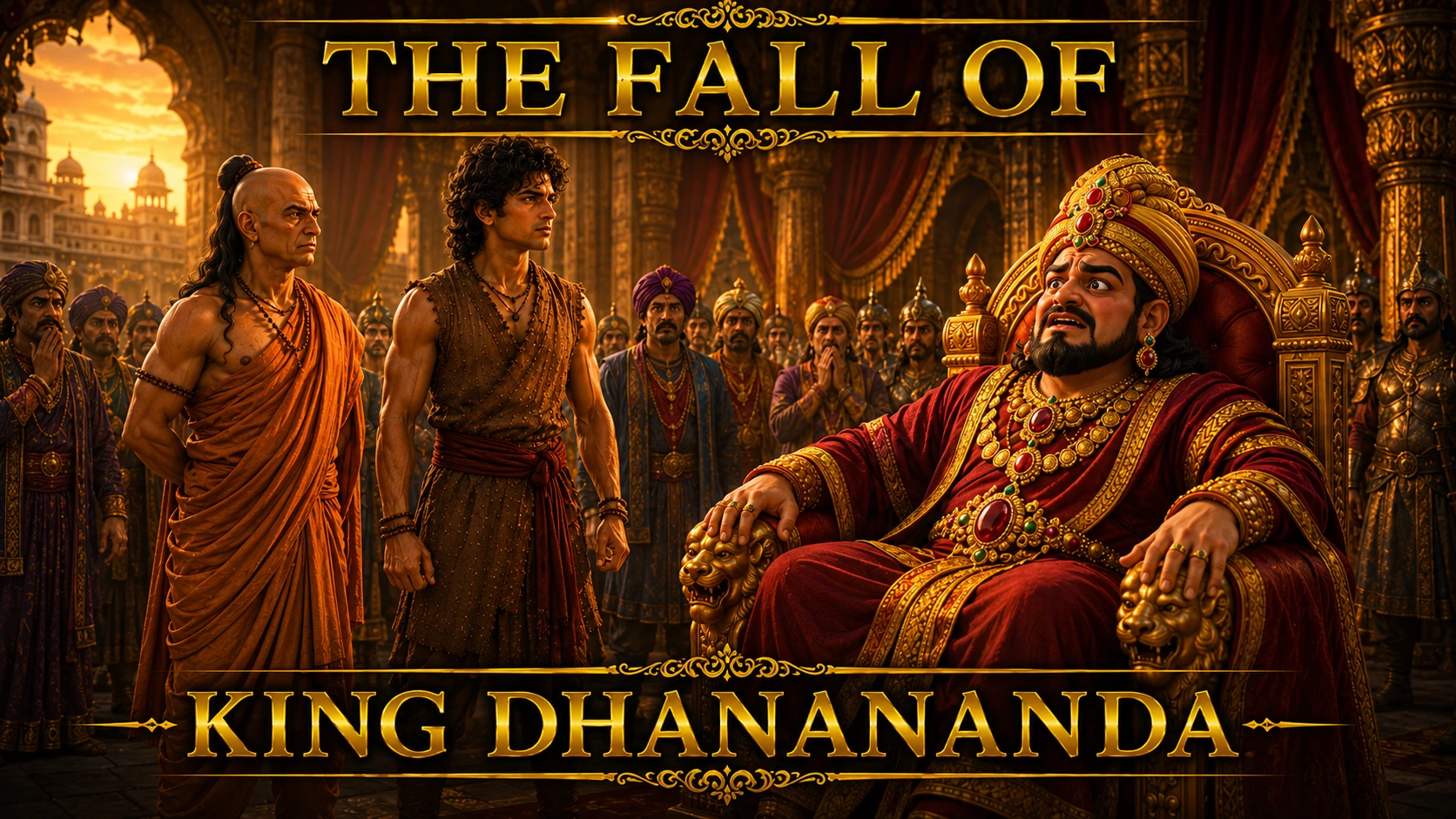
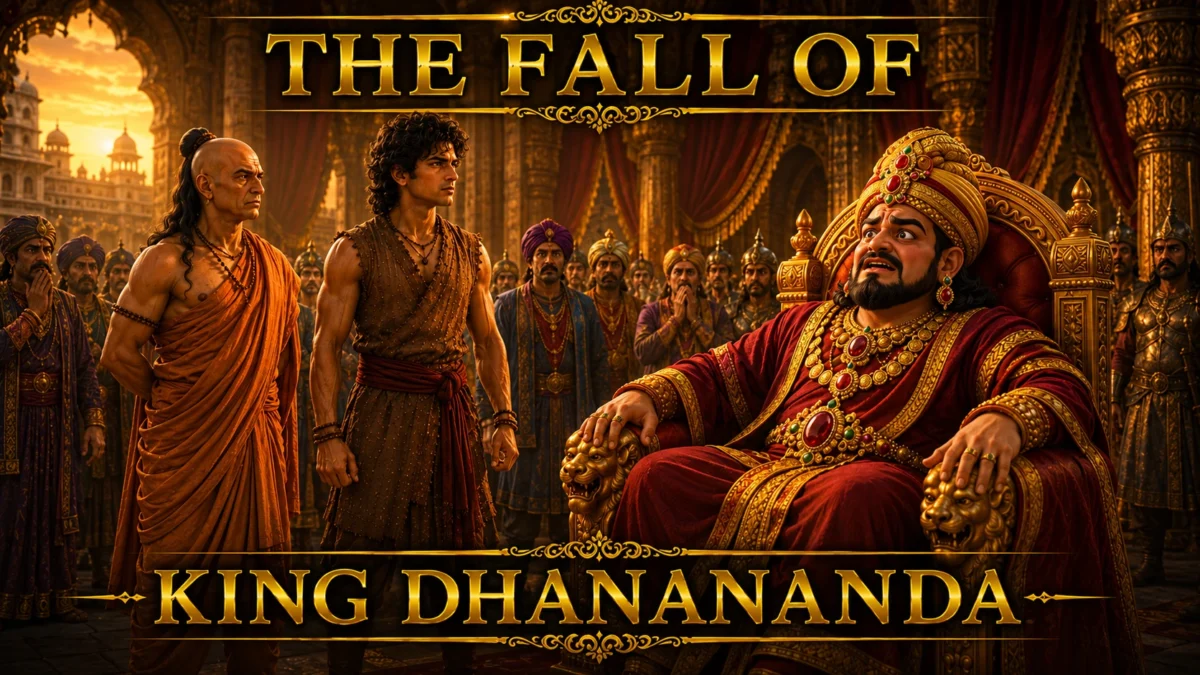
📖 The Fall of King Dhanananda: The End of Tyranny in Magadha (Part 19)
🌅 The Day History Finally Changed
The walls of Magadha still stood.
Its gates still guarded the capital.
Its banners still flew above the royal palace.
Yet everything had changed.
The final war had shaken the kingdom.
Years of strategy had begun producing results.
The alliances forged by Chanakya were working together.
The people of Magadha were no longer united behind their ruler.
And King Dhanananda, once feared across the land, now faced the greatest challenge of his life.
For years he had believed himself untouchable.
For years he had trusted wealth, fear, and power.
For years he had ignored the warning signs around him.
Now the consequences had arrived.
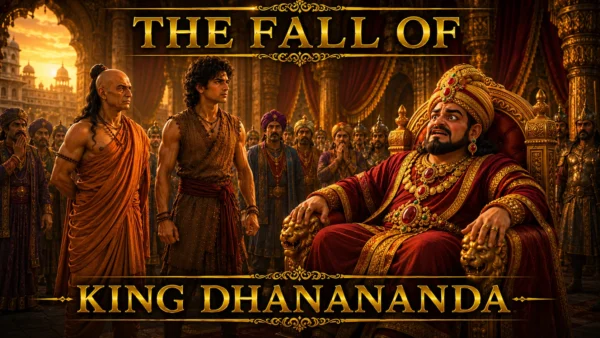
This was The Fall of King Dhanananda.
The moment Chanakya had waited for.
The moment Chandragupta had prepared for.
The moment history would never forget.
👑 A Throne Built on Fear
As reports arrived from across the kingdom, Dhanananda sat inside his palace surrounded by gold.
The treasure remained.
The throne remained.
The palace remained.
But something more important was disappearing.
Confidence.
The same ruler who once commanded absolute authority now faced uncertainty.
Ministers looked worried.
Officials exchanged nervous glances.
Military commanders spoke cautiously.
The king could feel the pressure.
Yet pride still prevented him from accepting reality.
Chanakya had once warned:
“A ruler who ignores truth eventually becomes its victim.”
Those words were becoming reality.
⚔️ The Consequences of Every Mistake
No kingdom falls in a single day.
Decline begins long before collapse becomes visible.
The greed that increased taxes.
The corruption that weakened trust.
The fear that silenced criticism.
The arrogance that ignored danger.
All these decisions had accumulated over time.
Now they returned like unpaid debts.
Every weakness discussed in Part 17 had become a burden on Magadha.
And every burden made resistance more difficult.
🌍 The People No Longer Believed
This was perhaps the greatest change of all.
The people of Magadha no longer viewed Dhanananda as an unquestioned ruler.
Years of hardship had changed public opinion.
Farmers remembered heavy taxation.
Merchants remembered unfair treatment.
Families remembered fear.
Citizens remembered corruption.
The throne still existed.
But loyalty had weakened.
And when loyalty disappears, even powerful rulers become vulnerable.
🧠 Chanakya Watches Quietly
While events unfolded, Chanakya remained calm.
He had imagined this moment many years earlier.
Not when he was powerful.
Not when he had influence.
But when he had been humiliated in Dhanananda’s court.
Most people would have chosen revenge.
Chanakya chose patience.
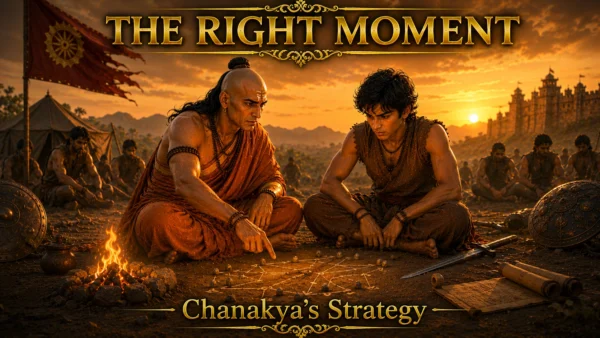
Instead of reacting emotionally, he created a strategy.
Instead of seeking immediate satisfaction, he prepared for lasting change.
Now that preparation was reaching its conclusion.
🔥 Chandragupta Leads with Purpose
Chandragupta had changed dramatically since his childhood.
He was no longer the boy raised by struggle.
He was no longer the impatient warrior who rushed into battle.
Now he stood as a disciplined leader.
The lessons of Chanakya had become part of his character.
Patience.
Wisdom.
Strategy.
Leadership.
Every challenge had shaped him.
And now those lessons guided him through the most important campaign of his life.
🌟 Event 1: The Coalition Holds Together
Many rulers expected the alliance to weaken during difficult moments.
Instead, it became stronger.
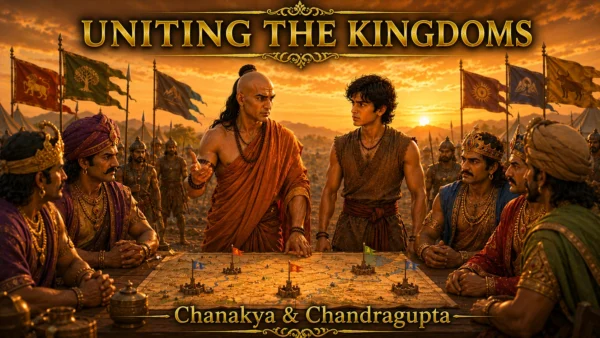
The kingdoms Chanakya united continued supporting one another.
Resources were shared.
Information flowed freely.
Trust remained strong.
This unity became one of the biggest reasons behind The Fall of King Dhanananda.
Because Magadha was no longer facing isolated opponents.
It was facing a movement.
🌟 Event 2: Public Support Shifts
Throughout the conflict, public opinion continued changing.
People wanted stability.
People wanted justice.
People wanted relief from corruption and fear.
Many began viewing Chandragupta as a symbol of hope.
This shift in perception mattered enormously.
Because rulers survive through public support.
And Dhanananda was losing it.
🌟 Event 3: Corruption Weakens Resistance
The corruption that once enriched officials now weakened the kingdom.
Some administrators acted inefficiently.
Others prioritized personal gain.
Several failed to perform their responsibilities effectively.
The system Dhanananda tolerated was now working against him.
Chanakya understood this perfectly.
Weak institutions create weak governments.
🏛️ The Mood Inside the Palace
Inside the royal court, anxiety increased.
Some advisors recommended compromise.
Others suggested stronger action.
Many simply hoped circumstances would improve.
But uncertainty continued growing.
The confidence that once filled the palace corridors was disappearing.
For the first time, even loyal supporters began questioning the future.
🌟 Event 4: Fear Stops Working
For years, fear had maintained control.
But fear becomes less effective when people believe change is possible.
Citizens who once remained silent started hoping for something better.
Officials who once obeyed automatically became uncertain.
The emotional foundation of Dhanananda’s rule was weakening.
And without that foundation, authority became harder to maintain.
⚖️ A Lesson About Leadership
Chanakya used this moment to teach Chandragupta something important.
“Remember what caused this downfall.”
The lesson was clear.
A ruler must never confuse obedience with respect.
A ruler must never place wealth above people.
A ruler must never stop listening.
These principles would later influence how Chandragupta governed.
🌟 Event 5: Dhanananda Underestimates Change
One of the greatest mistakes of his reign remained unchanged.
He continued underestimating how much circumstances had evolved.
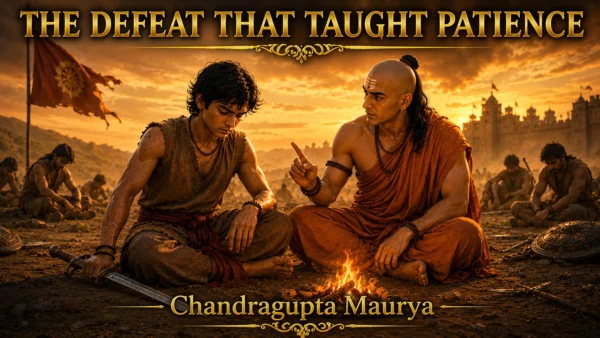
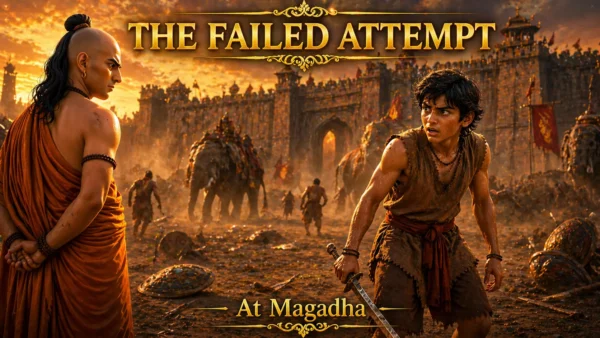
He remembered Chandragupta’s first failure.
But he failed to recognize Chandragupta’s growth.
He remembered old victories.
But ignored current realities.
This inability to adapt accelerated his decline.
👁️ The Difference Between Two Leaders
The contrast between Chandragupta and Dhanananda became obvious.
Dhanananda resisted change.
Chandragupta embraced learning.
Dhanananda relied on fear.
Chandragupta inspired loyalty.
Dhanananda ignored criticism.
Chandragupta listened carefully.
One leader was preparing for the future.
The other remained trapped by the past.
🌟 Event 6: The Kingdom Loses Confidence
Eventually, confidence became one of Magadha’s greatest challenges.
The military still existed.
The government still functioned.
The palace still stood.
Yet belief in long-term success continued weakening.
People sensed that change was approaching.
And once confidence begins disappearing, recovery becomes difficult.
🔥 The Promise Made Years Earlier
As events unfolded, Chanakya remembered the vow he had taken after his humiliation.
Many years had passed since that moment.
Many obstacles had appeared.
Many sacrifices had been required.
Yet he never abandoned his mission.
Not because of personal pride.
But because he believed Magadha deserved better leadership.
Now that promise was finally being fulfilled.
🌟 Event 7: The End of Tyranny
Every story reaches a turning point.
This was Magadha’s.
The era of fear was ending.
The era of corruption was ending.
The era of Dhanananda was ending.
History had chosen a new direction.
And nothing could stop it.
This became the defining moment in The Fall of King Dhanananda.
👑 Chandragupta Understands the Responsibility
As victory approached, Chandragupta did not celebrate recklessly.
Instead, he reflected.
He understood that replacing a ruler is easier than becoming a good ruler.
The mistakes of Dhanananda served as warnings.
The future emperor wanted to build something stronger.
Something fairer.
Something lasting.
This maturity impressed Chanakya deeply.
🌟 7 Powerful Events That Ended King Dhanananda’s Rule
1️⃣ The Coalition Remained United
2️⃣ Public Support Shifted
3️⃣ Corruption Weakened Resistance
4️⃣ Fear Lost Its Power
5️⃣ Dhanananda Underestimated Change
6️⃣ Confidence in the Kingdom Declined
7️⃣ The Era of Tyranny Finally Ended
🎯 Lessons From The Fall of King Dhanananda
✅ Wealth cannot replace trust.
✅ Fear cannot replace loyalty.
✅ Corruption weakens even powerful kingdoms.
✅ Arrogance blinds leaders.
✅ Unity creates strength.
✅ Patience defeats impulsiveness.
✅ Good leadership always outlasts tyranny.
🌟 Moral (The Fall of King Dhanananda)
A ruler may control a kingdom through fear for a time, but only justice and trust create lasting power.
✨ Conclusion (The Fall of King Dhanananda)
The Fall of King Dhanananda was more than the defeat of a king.
It was the collapse of a system built on fear, greed, and arrogance.
It was the fulfillment of Chanakya’s promise.
It was the reward for years of patience and strategy.
And it was the moment that opened the door for a new chapter in Indian history.
Magadha was changing.
The Nanda era was ending.
And a young leader named Chandragupta Maurya was about to step into destiny.
❓ Frequently Asked Questions About The Fall of King Dhanananda
1. What was The Fall of King Dhanananda?
The Fall of King Dhanananda refers to the end of the Nanda ruler’s reign after years of growing internal weaknesses and strategic opposition led by Chanakya and Chandragupta Maurya.
2. Why did King Dhanananda lose power?
He lost power due to greed, corruption, fear-based rule, declining public support, and underestimating his opponents.
3. How did Chanakya contribute to Dhanananda’s downfall?
Chanakya built alliances, developed long-term strategies, identified weaknesses in Magadha, and guided Chandragupta Maurya.
4. What role did Chandragupta Maurya play?
Chandragupta united supporters, led campaigns, and emerged as the leader capable of replacing Dhanananda.
5. What were the biggest weaknesses of King Dhanananda?
Greed, corruption, arrogance, excessive taxation, fear-based governance, and ignoring honest advice.
6. Why was public support important?
Public support influences stability. As confidence in Dhanananda declined, his position weakened.
7. Did alliances help bring down Dhanananda?
Yes. The alliances created by Chanakya united multiple kingdoms behind a common purpose.
8. What leadership lessons come from Dhanananda’s fall?
Leaders must value trust, humility, justice, and continuous learning.
9. How did The Fall of King Dhanananda change history?
It cleared the path for Chandragupta Maurya and the rise of the Maurya Empire.
10. What happened after The Fall of King Dhanananda?
The rise of Chandragupta Maurya and the beginning of a new era under the Maurya Empire.
📖 Continue the Chanakya Series
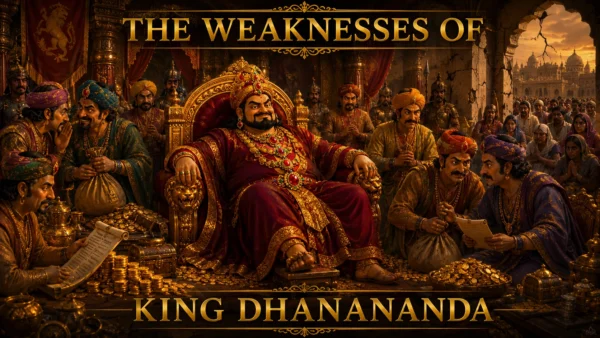
⬅ Part 17: The Weaknesses of King Dhanananda
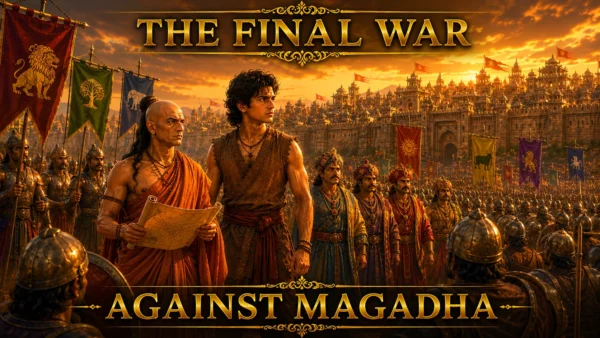
⬅ Part 18: The Final War Against Magadha
👑 The tyrant had fallen. Now an empire was about to rise. 🌟🏛️👑
- The Puzzle That Confused the Entire Court – An Akbar Birbal Story

- King Akbar Asked for Proof of God – Birbal’s Answer Shocked Everyone
- Everyone Believed He Was Guilty… Birbal’s One Answer Changed the Verdict
- Akbar Passed Judgment in a Hurry… Birbal Made Him Listen
- The Scholar Spoke for Hours… Birbal Answered Without a Single Word
- Akbar Lost His Ring Inside the Court… No One Could Find It Until Birbal Spoke
📣 YouTube Channel Subscribe Line
👉 Subscribe to our YouTube channel for more beautiful moral stories for kids!
🔗 YouTube Channel – A Moral Stories (English)









Post Comment