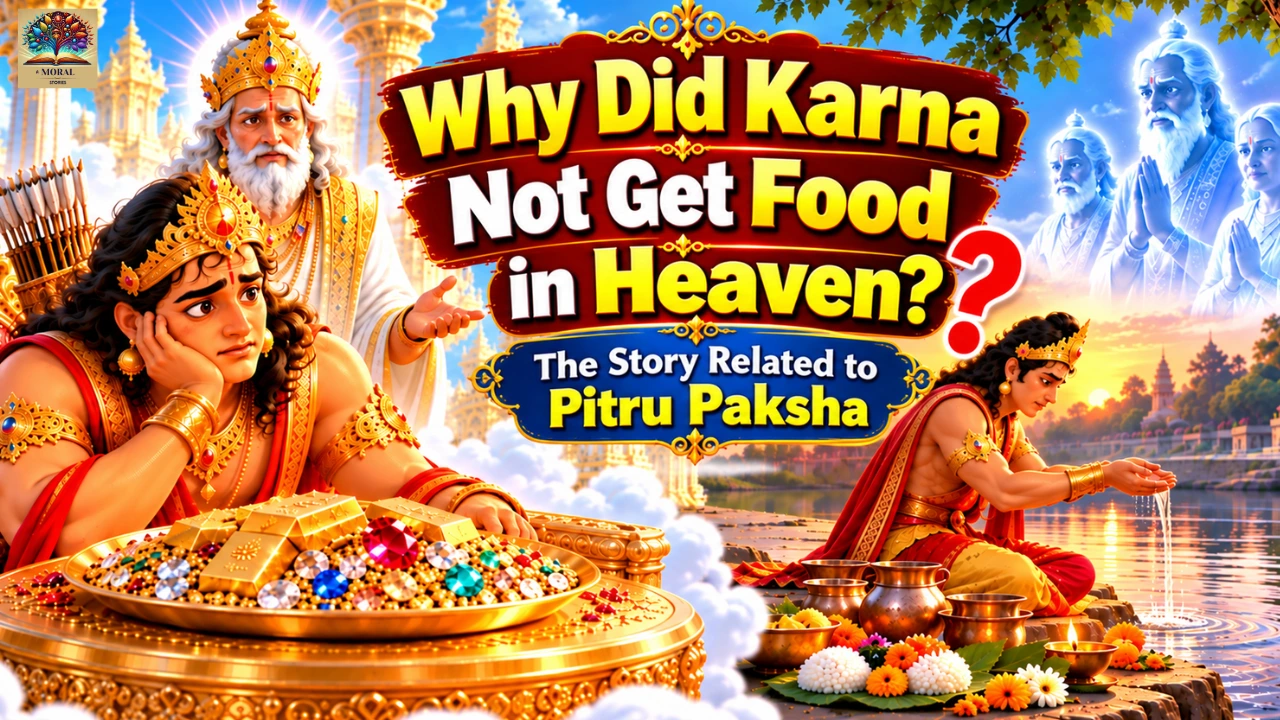
🌺 Introduction – Why Did Karna Not Get Food in Heaven? The Story of Karna and Pitru Paksha
The story of Karna, one of the most remarkable characters associated with the Mahabharata, is remembered for courage, loyalty, sacrifice and extraordinary generosity.
Karna is popularly known as Daanveer Karna, the great giver. According to traditional stories, anyone who came to his door asking for help was rarely disappointed. Whether a poor person, a Brahmin, or someone in need, Karna was always ready to give.
But a fascinating question arises in the popular tradition connected with Karna and Pitru Paksha:
If Karna was such a great giver, why did he not get food in heaven?
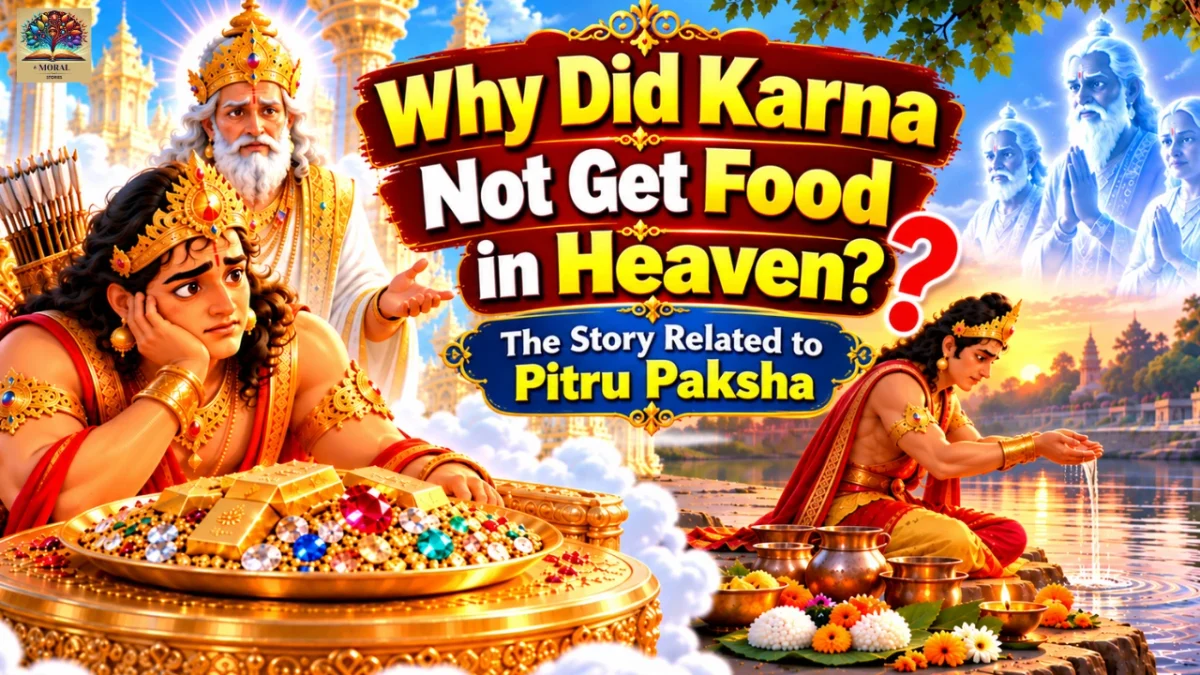
Why was his golden plate filled with gold and precious jewels instead of rice, vegetables, fruits, sweets and water?
The answer forms the heart of this beautiful traditional story.
It teaches us that charity is not only about wealth and material possessions. Food, water, gratitude, family bonds and remembrance of our ancestors also have an important place in our lives.
So, let us understand the complete Karna Pitru Paksha story in the same sequence in which this traditional tale is told.
🌺 Full Story- Why Did Karna Not Get Food in Heaven? The Story of Karna and Pitru Paksha
🌺 Who Was Karna?
Karna is one of the most complex and memorable figures in the Mahabharata tradition.
He was known for his extraordinary bravery, generosity and determination. His life was filled with difficult circumstances, difficult decisions and emotional struggles.
From childhood, Karna faced challenges that shaped his personality. Despite many hardships, he became a great warrior and earned the name Daanveer Karna because of his willingness to give.
His generosity became so famous that people believed that no person who approached Karna for a genuine gift would return empty-handed.
Karna’s attitude toward charity was simple:
If someone came to his door in need, he would try to help.
Gold, ornaments, wealth and other valuable possessions could be given away without hesitation.
This quality made Karna famous throughout the traditional stories of the Mahabharata.
But there was one aspect of giving that, according to this popular retelling, Karna had overlooked.
And that forgotten duty became important after his death.
🌺The Great War of Mahabharata Comes to an End
Long ago, the great war of Kurukshetra finally came to an end.
The battlefield that had once been filled with warriors, chariots, weapons and powerful armies became silent.
Many great warriors had fallen.
Among them was Karna, the legendary warrior remembered for his courage and generosity.
After Karna’s earthly life came to an end, his soul began its journey beyond the physical world.
According to the traditional story, Karna eventually reached heaven.
He had lived a life filled with generosity and had given away enormous amounts of wealth.
Therefore, he expected that the afterlife would bring him peace and happiness.
But what happened next surprised him.
🌺 Karna Reaches Heaven
As Karna’s soul reached heaven, he saw a world unlike anything he had ever experienced on Earth.
There was divine light everywhere.
Beautiful golden palaces appeared to shine brightly. Fragrant flowers filled the surroundings. The atmosphere was peaceful and filled with beautiful music.
Everything looked perfect.
Karna was welcomed with great respect.
A divine attendant greeted him and said,
“Welcome, brave Karna.”
Karna entered the magnificent heavenly world.
He was taken toward a beautiful palace decorated with gold and precious ornaments.
Inside the palace was a magnificent golden throne.
Karna looked around with wonder.
After everything he had suffered on Earth, he thought that perhaps his journey had finally reached a peaceful end.
But then came the time for his meal.
And that was when something very strange happened.
🌺Karna Is Served a Golden Plate
A divine servant entered carrying a beautiful golden plate.
Karna looked at the plate.
He expected to see food.
Perhaps rice.
Perhaps vegetables.
Perhaps fruits and sweets.
Perhaps delicious heavenly food.
But when he looked closely, he was shocked.
There was no food on the plate.
There was no grain.
There were no vegetables.
There were no fruits.
There was no water.
Instead, the plate was filled with gold and precious jewels.
Karna stared at it in disbelief.
He could not understand what was happening.
He asked,
“What is this? Where is my food?”
The divine servant calmly replied,
“This is your meal.”
Karna was completely shocked.
He looked at the gold and precious stones.
How could anyone eat gold?
How could jewels satisfy hunger?
Karna had given away gold throughout his life, but gold was not food.
For the first time, the great giver found himself facing something he could not solve simply by giving away wealth.
🌺Why Was Karna Not Given Food in Heaven?
Karna could not understand why this was happening.
He had always helped people.
He had donated gold.
He had given jewelry.
He had helped the poor.
He had supported Brahmins and people who came to him seeking assistance.
He had never wanted a needy person to return from his door disappointed.
So why was he now hungry?
Why did he receive gold instead of food?
At that moment, a divine person appeared before Karna.
Karna respectfully asked for an explanation.
The divine person told him that this was not necessarily a punishment for committing a crime.
Rather, according to this traditional story, it was connected with an incomplete part of his giving and duties.
Karna was confused.
He said that he had donated almost everything people could ask for.
He had given wealth.
He had given gold.
He had given jewelry.
He had given land.
He had helped those in need.
He had never turned away someone who came to his door asking for help.
Then the divine person asked him a simple question:
“Did you ever offer food and water to your ancestors?”
Karna became silent.
That question made him think deeply.
🌺 Karna Realizes What He Had Forgotten
Karna searched his memories.
He remembered all the gifts he had given during his lifetime.
He remembered the people who came to him.
He remembered gold, ornaments, wealth and other possessions.
But he realized that he had not knowingly offered food and water to his ancestors.
Karna then explained that he had not deliberately ignored them.
His own life circumstances had been complicated.
He had grown up without knowing the complete truth about his birth and lineage.
He learned important truths about his family only later in life.
Because of this, he had not properly understood or performed certain ancestral offerings.
The divine person listened to Karna.
Then came the explanation.
🌺 The Connection Between Karna and Pitru Paksha
According to this popular traditional retelling, Karna’s problem was not that he had failed to donate wealth.
His problem was that he had given material wealth but had not offered food and water in remembrance of his ancestors.
This is where the story becomes connected with Pitru Paksha and Shraddha traditions.
The lesson is symbolic and powerful.
A person may have enormous wealth.
A person may donate gold.
A person may give expensive gifts.
A person may help many people.
But food and water are basic necessities of life.
And remembering one’s ancestors with gratitude represents an important family and spiritual connection.
The story therefore reminds people that generosity should not be limited to material possessions.
🌺 Why Did Karna Return to Earth?
Karna explained that he had not intentionally neglected his ancestors.
He simply did not fully understand what he needed to do.
The divine person understood his situation.
Karna was not simply dismissed.
Instead, he was given an opportunity.
According to the popular story, Karna was allowed to return to Earth so that he could remember his ancestors and offer food and water with sincerity.
This gave Karna a chance to complete what he had overlooked during his earthly life.
Karna accepted the opportunity.
He returned to Earth.
But this time, he returned with a different understanding of charity.
🌺 Karna’s Change After Returning to Earth
When Karna came back to Earth, he was no longer thinking only about gold and material wealth.
He had learned something much deeper.
He understood that giving money is not the only form of charity.
Food is also charity.
Water is also charity.
Helping a hungry person is also charity.
Remembering parents and ancestors with gratitude is also important.
Karna’s heart became more humble.
There was no desire to show people how much he could give.
There was no pride.
There was only gratitude.
He remembered his ancestors.
He prepared food.
He offered water.
He performed the offering with श्रद्धा, respect and a sincere heart.
The important part was not the value of the food.
The important part was the feeling behind the offering.
🌺Karna Offers Food and Water With श्रद्धा
Karna now understood that true giving is not about displaying wealth.
He offered food to his ancestors with respect.
He offered water with gratitude.
He remembered those who had come before him.
There was no desire for fame.
There was no desire to impress anyone.
He simply wanted to express gratitude.
This became the emotional turning point of the story.
The great Daanveer Karna, who had already learned how to give wealth, now learned another form of giving—the giving of food and water with devotion and remembrance.
His earthly period eventually came to an end.
And once again, Karna returned to heaven.
But this time, something was completely different.
🌺 Karna Returns to Heaven Again
When Karna reached heaven again, he entered the same beautiful surroundings.
The golden palaces were still there.
The flowers were still fragrant.
The divine music was still playing.
But now it was time for his meal.
A divine servant once again brought a golden plate.
Karna looked at it.
He remembered what had happened before.
He wondered whether the plate would once again contain gold and precious stones.
But when he looked inside, he was pleasantly surprised.
This time, the golden plate was filled with delicious food.
There was grain.
There were fruits.
There were sweets.
There was water.
There was everything he needed to satisfy his hunger.
Karna smiled.
He finally understood the deeper lesson behind what had happened to him.
The gold he had given throughout his life had brought him gold.
But the food and water he had offered with sincere remembrance now brought him the food and water he needed.
🌺 What Is the Moral of Karna’s Story?
The story of why Karna did not get food in heaven is ultimately a story about the deeper meaning of charity.
Karna was not remembered as Daanveer because he was rich alone.
He was remembered because he was willing to give.
But this traditional story adds another layer to his character.
It teaches that giving should be thoughtful.
We should not only give what looks valuable.
We should also understand what another person actually needs.
A hungry person needs food.
A thirsty person needs water.
A struggling person may need support.
A lonely person may need kindness.
A family member may need our time.
And our ancestors deserve remembrance and gratitude according to the traditions we follow.
🌺 7 Powerful Life Lessons From Karna’s Story
1. Charity Is More Than Money
The biggest lesson from this story is that charity is not limited to money.
Food, water, kindness, support and compassion can all be forms of giving.
A person does not need to be extremely wealthy to become generous.
Even a small act done sincerely can have great value.
2. Food Is One of the Most Important Forms of Giving
Food is a basic necessity.
When someone is hungry, giving them food can be more meaningful than giving them something expensive.
This is why food donation has such an important place in many Indian traditions.
The story reminds us that wealth cannot replace basic necessities.
3. Water Should Never Be Taken for Granted
Water is essential for life.
Offering water to someone who is thirsty is a simple but meaningful act of kindness.
The traditional Karna story repeatedly connects food and water with remembrance and giving.
It teaches us to value things that sustain life.
4. Never Forget Your Roots
Karna spent his life helping others, but according to this traditional story, he overlooked his ancestral connection.
The lesson is not about guilt.
It is about remembering where we come from.
Parents, grandparents, ancestors and family traditions connect us to our roots.
Remembering them with gratitude can help us remain humble.
5. Giving Should Not Become a Matter of Pride
Karna was famous for his generosity.
But true charity should not be about showing others how much we have.
The best giving is often quiet.
When we help someone without expecting praise, our act becomes more meaningful.
6. Understand What People Actually Need
Imagine giving gold to a person who is hungry.
Gold may be valuable, but it cannot satisfy hunger.
This is one of the most powerful ideas in the story.
The best help is help that meets a real need.
Instead of asking, “How much can I give?” we can sometimes ask:
“What does this person actually need?”
7. Gratitude Is Also a Form of Giving
The story teaches us to remember those who helped make our lives possible.
Parents, grandparents, teachers, elders and ancestors all represent different parts of our journey.
Gratitude does not always require money.
Sometimes remembering someone with love and respect is itself meaningful.
🌺 Karna and Pitru Paksha: What Is the Connection?
The traditional Karna and Pitru Paksha story is popularly told to explain the importance of ancestral remembrance, Shraddha and food and water offerings.
According to the popular retelling, Karna’s generosity toward the living was extraordinary, but he had not offered food and water in remembrance of his ancestors.
When he reached heaven, he received gold and jewels instead of food.
He was then given an opportunity to return to Earth and complete this forgotten duty.
After he offered food and water with sincerity, he returned to heaven and received food.
This is why Karna’s story is often associated with Pitru Paksha.
A note about the tradition
This heaven-and-food episode should be understood as a popular mythological/traditional retelling associated with Pitru Paksha, rather than presented as an undisputed episode directly narrated in the core Mahabharata text. Different retellings may vary in details, including who explains Karna’s situation and how long he returns to Earth.
The central message, however, remains similar: charity, food, water, remembrance and gratitude all have value.
🌺 What Does Karna’s Story Teach Children?
This story is especially meaningful for children because it explains complicated ideas through a simple example.
Children can learn that:
- We should help people in need.
- We should not waste food.
- We should offer water to someone who needs it.
- We should respect parents and elders.
- We should remember our family roots.
- We should not show off when helping others.
- We should be grateful for what we have.
- Giving is not only about expensive things.
- Kindness can be more valuable than material possessions.
- We should learn from our mistakes.
The story also teaches children that even a great person can have something to learn.
Karna was already famous for his generosity, yet the story gave him another important lesson.
🌺 Simple Activities for Children Based on Karna’s Story
Parents and teachers can turn this story into a small learning activity.
Activity 1: Food Donation
Ask children to collect a small amount of food or help serve food to someone in need.
Activity 2: Water Awareness
Teach children not to waste water.
Ask them to think about how important water is for people, animals and plants.
Activity 3: Gratitude List
Ask children to write the names of five people they are grateful to.
For example:
- Parents
- Grandparents
- Teachers
- Friends
- Family members
Activity 4: Draw Karna in Heaven
Children can draw Karna sitting before a golden plate and then draw the second scene where the plate contains food.
Activity 5: Story Discussion
Ask:
“If you were Karna, what would you learn from this experience?”
This encourages children to understand the moral instead of simply memorizing the story.
🌺Frequently Asked Questions About Karna and Pitru Paksha (Why did Karna not get food in heaven?)
1. Why did Karna not get food in heaven?
According to the popular traditional story, Karna received gold and precious jewels instead of food because he had generously donated wealth during his life but had not offered food and water in remembrance of his ancestors.
2. Why did Karna receive gold instead of food?
The traditional story explains that Karna received what was symbolically connected to the kind of material giving he had performed during his lifetime. Since he had given enormous amounts of gold and wealth, gold appeared in place of food.
3. What is the connection between Karna and Pitru Paksha?
The popular Karna Pitru Paksha story connects Karna with ancestral remembrance. After reaching heaven, Karna realizes that he had not offered food and water to his ancestors and is given an opportunity to return to Earth and do so.
4. What did Karna learn after reaching heaven?
Karna learned that charity is not only about giving wealth. Food, water, remembrance of ancestors, gratitude and helping people according to their actual needs are also important.
5. Why did Karna return to Earth?
According to the traditional retelling, Karna was allowed to return to Earth so that he could offer food and water to his ancestors and complete the duty he had overlooked.
6. What is the moral of Karna’s story?
The main moral is that true charity should include compassion, food, water, gratitude and helping others according to their needs. Giving should also be done without pride.
7. Is the story of Karna getting no food in heaven in the Mahabharata?
This particular heaven-and-food episode is best described as a popular traditional or mythological retelling associated with Pitru Paksha. Details vary across different versions, so it should not be presented as a universally identical episode of the core Mahabharata narrative.
8. What did Karna donate during his life?
Karna is traditionally remembered as an extraordinary giver who donated wealth, gold, jewelry and other valuable possessions and helped people who approached him for assistance.
9. Why is Karna called Daanveer Karna?
Karna is popularly called Daanveer, meaning a great or heroic giver, because of his extraordinary reputation for generosity and his willingness to give to people who came to him seeking help.
10. What is the main lesson of the Karna and Pitru Paksha story?
The central lesson is that wealth is not the only thing that matters. Food, water, kindness, gratitude, ancestral remembrance and helping people according to their real needs are also important forms of giving.
🌺Conclusion: The Deeper Meaning of Karna’s Story (Why did Karna not get food in heaven?)
The story of why Karna did not get food in heaven is much more than a story about a golden plate.
It is a story about understanding the true meaning of giving.
Karna was already famous for his generosity.
He had given gold.
He had given wealth.
He had helped poor and needy people.
He had earned the name Daanveer Karna.
Yet, according to this popular traditional retelling, there was still one important thing he had overlooked—offering food and water in remembrance of his ancestors.
When he reached heaven, the gold and jewels on his plate could not satisfy his hunger.
That moment taught him something profound.
Not everything valuable can be measured in gold.
Food has value.
Water has value.
Family has value.
Gratitude has value.
Kindness has value.
And remembering our roots has value.
Karna was then given an opportunity to return to Earth. He offered food and water with sincerity, respect and gratitude. When he returned to heaven, the golden plate was finally filled with food.
The story therefore leaves us with a beautiful message:
True charity is not about how much we give. It is about understanding what is needed and giving with a sincere heart.
We should help the needy.
We should never waste food.
We should respect water.
We should care for our family.
We should remember our elders and ancestors with gratitude.
And most importantly, we should never allow generosity to become a reason for pride.
That is the deeper lesson behind the traditional Karna and Pitru Paksha story—a lesson that remains meaningful for children and adults alike.
Karna teaches us that the greatest form of giving is not simply giving what we have, but giving what is truly needed, with compassion, humility and gratitude.
🔗 You may also like
👉 Read more inspiring stories:
👉 The Neem Tree and the Brave Animals Moral Story: 7 Brave Animals Who Saved Their Home
👉 A Grandfather’s Powerful Secret: The Two Wolves Story with Moral That Can Change Your Life
👉 Horse and Donkey Short Story About Helping Others for Kids (With Moral)
👉 Read more Hindu God stories:
👉 Little Hanuman and the Sun God
👉 Why Lord Hanuman Is Called Chiranjivi?
👉 Why Lord Vishnu Took Matsya Avatar
👉 Dashavatara Story for Kids in English
- The Rise of Chandragupta Maurya: The Birth of the Maurya Empire (Part 20)

- The Fall of King Dhanananda: The End of Tyranny in Magadha (Part 19)
- The Final War Against Magadha: The Battle That Changed Indian History (Part 18)
- The Weaknesses of King Dhanananda: The Cracks That Threatened Magadha (Part 17)
- How Chanakya United Small Kingdoms: The Alliance That Challenged Magadha (Part 16)
- Chanakya’s Lesson of the Right Moment: The Wisdom That Changed Chandragupta Forever (Part 15)

📣 YouTube Channel Subscribe Line
👉 Subscribe to our YouTube channel for more beautiful moral stories for kids!
🔗 YouTube Channel – A Moral Stories (English)





Post Comment