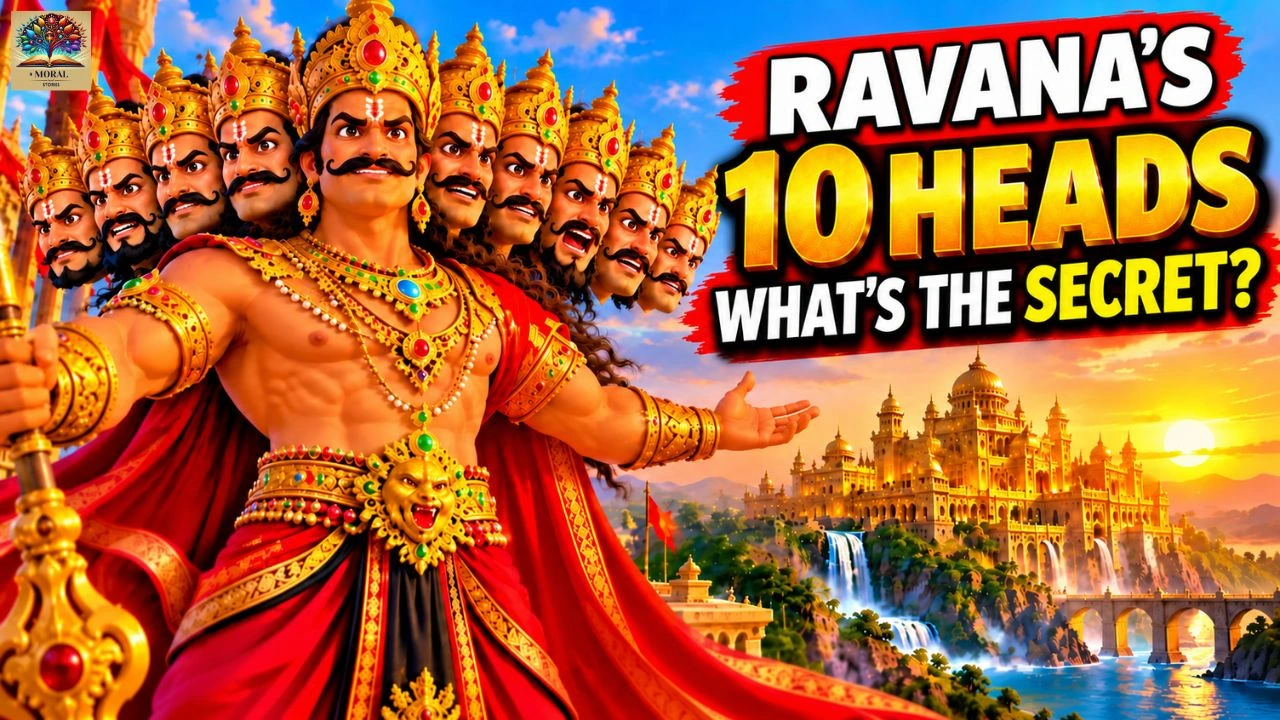
🌺 Introduction: What Was the Secret Behind Ravana’s 10 Heads?
Whenever we hear the story of the Ramayana, one of the first characters that comes to mind is Ravana, the powerful king of Lanka. His ten heads, twenty arms, golden kingdom, extraordinary knowledge, and devotion to Lord Shiva make him one of the most fascinating figures in Hindu mythology.
But have you ever wondered about the secret behind Ravana’s 10 heads? Why did Ravana have ten heads? Were they a sign of his supernatural powers, his vast knowledge, or something deeper?
Ravana is remembered as a powerful king, a great scholar, a skilled warrior, and a devoted follower of Lord Shiva. Yet, despite his remarkable abilities, his pride and decisions ultimately led to his downfall.
Different Ramayana traditions and popular legends offer different explanations for Ravana’s ten heads. Some interpretations connect them with his knowledge and extraordinary abilities, while others understand them as symbols of human weaknesses such as anger, greed, pride, and uncontrolled desire.
In this article, we will explore Ravana’s birth and family, his devotion to Lord Shiva, the legends associated with his ten heads, five fascinating secrets, and the important life lessons hidden within his story.
Let us discover the secret behind Ravana’s 10 heads and understand why the story of Ravana continues to fascinate readers across generations.
🌺 Secret Behind Ravana’s 10 Heads : The Complete Mythological Story
🌺 Who Was Ravana? The Powerful King of Lanka
Ravana was the king of Lanka and one of the central characters in the Hindu epic Ramayana. He was known for his extraordinary strength, intelligence, ambition, and knowledge.
Traditional accounts portray him as a learned scholar who studied sacred texts and mastered various forms of knowledge. He was also associated with music, devotion, and the worship of Lord Shiva.
Ravana ruled a prosperous kingdom and possessed immense wealth and power. His golden Lanka is remembered in traditional storytelling as a magnificent city filled with riches and grandeur.
However, Ravana’s personality had two contrasting sides. On one side, he possessed intelligence, determination, and devotion. On the other, his arrogance and desire to have things his own way led him to make destructive decisions.
This contrast is central to understanding Ravana’s story. His life reminds us that knowledge and power alone cannot guarantee wisdom or good judgment.
🌺 Ravana’s Birth and Family: The Story Behind the King
According to traditional accounts, Ravana was the son of the sage Vishrava and Kaikesi.
Vishrava was a respected sage associated with spiritual knowledge and learning. Kaikesi was Ravana’s mother. Their son grew up in a family connected with both wisdom and extraordinary ambition.
Ravana had several siblings, including Kumbhakarna and Vibhishana, as well as his sister Shurpanakha.
Although they belonged to the same family, the siblings were remembered for their very different personalities.
Ravana sought power, victory, and authority. He was ambitious, intelligent, and determined to expand his influence.
Kumbhakarna was known for his enormous size and extraordinary physical strength. His story is closely associated with his unusual sleep and his role in the war against Rama.
Vibhishana was known for his commitment to righteousness. When Ravana refused to correct his wrongdoing, Vibhishana advised him to return Sita to Rama. Eventually, Vibhishana left Ravana’s side and supported Rama.
Shurpanakha played an important role in the events leading to the conflict between Rama and Ravana.
The family’s different choices reveal an important lesson: people may come from the same family but follow very different paths. Their actions and decisions help shape their character and destiny.
Understanding Ravana’s family also helps us see that his downfall was not simply a matter of lacking intelligence or strength. It was connected to the choices he made despite receiving advice from those around him.
🌺 Ravana’s Devotion to Lord Shiva
One of the most fascinating aspects of Ravana’s personality was his devotion to Lord Shiva.
In Hindu mythological traditions, Ravana is remembered as a devoted worshipper of Shiva. Several popular legends describe his intense penance and determination to please his chosen deity.
According to a well-known traditional account, Ravana performed severe austerities to seek Lord Shiva’s blessings. His devotion is often portrayed as extraordinary because of the intensity with which he pursued his spiritual goal.
Ravana is also traditionally associated with the famous Shiva Tandava Stotram, a hymn praising Lord Shiva. The hymn is celebrated for its powerful rhythm and devotional expression, although accounts of its origin vary across traditions.
Ravana’s devotion is an important part of his story because it reveals his determination and spiritual ambition.
However, his life also raises a deeper question: is devotion enough if a person refuses to control their ego?
Ravana’s story suggests that religious devotion and intellectual ability must be accompanied by humility, compassion, and righteous conduct. A person may possess remarkable talents, but those talents can be undermined by harmful decisions.
🌺 How Did Ravana Get His Ten Heads?
One of the most frequently asked questions is: How did Ravana get 10 heads?
A popular legend connects Ravana’s ten heads with his intense penance to please Lord Shiva.
According to this version of the story, Ravana undertook severe austerities as an act of devotion. In some retellings, he offered his heads one by one to demonstrate the depth of his dedication.
When Ravana was about to complete his extraordinary sacrifice, Lord Shiva appeared, pleased with his devotion. In this popular account, Shiva restored Ravana’s heads and granted him blessings.
This story is commonly used to explain Ravana’s extraordinary appearance and his association with ten heads.
However, the details differ among traditional retellings, and this is not the only explanation associated with Ravana’s ten heads. It is best understood as a popular mythological account rather than a single explanation accepted by every Ramayana tradition.
The story highlights Ravana’s intense determination and devotion. At the same time, his later choices remind us that spiritual blessings cannot replace good judgment and self-control.
🌺 Why Is Ravana Called Dashanana?
Ravana is commonly known by the name Dashanana.
The Sanskrit-derived word Dashanana is generally understood to mean “the one with ten faces.” The name reflects Ravana’s traditional depiction with ten heads.
He is also associated with the name Dashagriva, which refers to his ten-necked form in traditional interpretations.
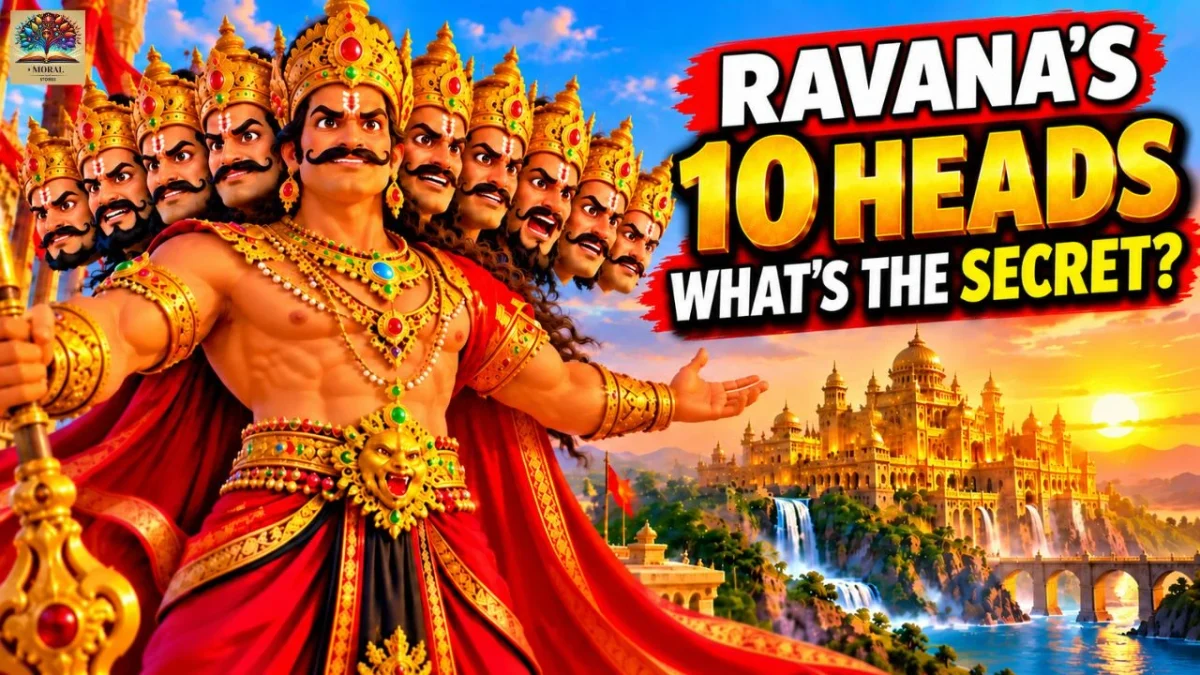
Ravana’s ten-headed appearance became one of the most recognizable features of his character in religious art, storytelling, and depictions of the Ramayana.
Yet, the meaning of the ten heads goes beyond the physical image. Different interpretations associate them with his learning, his extraordinary nature, or the many weaknesses that can affect human behaviour.
To understand the symbolism more clearly, let us explore five fascinating secrets associated with Ravana’s ten heads.
🌺 The Secret Behind Ravana’s 10 Heads: 5 Amazing Secrets
🌺 Secret 1: The Ten Heads Represented Extraordinary Knowledge
One popular interpretation connects Ravana’s ten heads with his vast knowledge.
Ravana is traditionally portrayed as a learned figure who possessed extensive knowledge of sacred texts and various disciplines. His ten heads are sometimes explained as a symbolic representation of his intellectual abilities.
A widely repeated interpretation connects the ten heads with the four Vedas and six auxiliary disciplines associated with Vedic learning.
The four Vedas are:
- Rigveda
- Samaveda
- Yajurveda
- Atharvaveda
The six traditional auxiliary disciplines are:
- Shiksha — pronunciation and phonetics
- Vyakarana — grammar
- Nirukta — explanation of words
- Chandas — poetic metre
- Jyotisha — astronomical calculations and calendrical knowledge
- Kalpa — ritual procedures
This explanation emphasizes Ravana’s reputation for scholarship and learning.
However, it is a popular interpretation of the symbolism, not a universally accepted scriptural explanation for why he had ten heads.
The deeper lesson is that knowledge is valuable, but it becomes truly meaningful when it is guided by wisdom and used responsibly.
🌺 Secret 2: The Ten Heads Symbolized Human Weaknesses
Another popular interpretation explains Ravana’s ten heads as symbols of human weaknesses.
According to this moral interpretation, the ten heads represent negative qualities that can influence people when they lose control over their thoughts and actions.
These qualities are often described as:
- Kama: Uncontrolled desire.
- Krodha: Anger.
- Lobha: Greed.
- Moha: Attachment or delusion.
- Mada: Pride or arrogance.
- Matsarya: Jealousy or envy.
- Ahankara: Ego.
- Injustice: Disregard for what is right.
- Cruelty: Lack of compassion.
- Abuse of power: Using strength to dominate others.
Different explanations may use different lists. This is a symbolic moral interpretation rather than a fixed list found identically in every version of the Ramayana.
The message is simple: everyone has weaknesses, but we must learn to recognize and control them.
Ravana’s story encourages us to look within ourselves rather than focus only on the mistakes of others.
🌺 Secret 3: The Ten Heads Represented Ravana’s Complex Personality
Ravana was not portrayed as a character with only one quality. His story contains many contrasting aspects.
He was learned but sometimes unwise. He was devoted to Lord Shiva but also proud. He possessed extraordinary strength but failed to correct his most damaging decisions.
The image of ten heads can be understood symbolically as a way of expressing this complex personality.
Each head may remind readers of a different side of human nature: intelligence, ambition, desire, anger, pride, and the struggle to control one’s actions.
This interpretation helps explain why Ravana remains such a compelling figure in the Ramayana.
His story reminds us that people can possess admirable qualities while still making serious mistakes. True character is revealed not only by what we know or achieve, but also by the choices we make.
🌺 Secret 4: The Ten Heads Were Associated with Ravana’s Extraordinary Nature
In traditional depictions, Ravana’s ten heads and twenty arms emphasize his extraordinary power and imposing presence.
His appearance sets him apart from ordinary kings and warriors. It visually communicates the scale of his strength and the challenge he presents to Rama.
Some popular retellings also connect his unusual appearance with his supernatural abilities and the mysterious aspects of his character.
These interpretations vary, so they should not be treated as one universally established explanation for his ten heads.
The larger point is that Ravana’s appearance symbolizes a figure of enormous power whose actions have consequences beyond his own life.
His story teaches that extraordinary abilities must be balanced with responsibility and restraint.
🌺 Secret 5: Ravana’s Pride Ultimately Led to His Downfall
The fifth and perhaps most important secret is the connection between Ravana’s pride and his downfall.
Ravana possessed knowledge, strength, wealth, and a powerful kingdom. Yet, his decisions brought him into conflict with Rama.
In the Ramayana, Ravana abducts Sita, the wife of Rama. This act becomes a central cause of the conflict between them.
Ravana’s brother Vibhishana advises him to return Sita and avoid further destruction. However, Ravana refuses to accept this advice.
His pride prevents him from correcting his actions, and the conflict escalates into a great war.
Eventually, Rama defeats Ravana.
This story highlights a powerful lesson: even a person with extraordinary intelligence and strength can fall when arrogance overcomes judgment.
Ravana’s ten heads may be interpreted in different ways, but his story consistently invites reflection on the relationship between power, responsibility, and character.
🌺 Did Rama’s Arrows Cut Off Ravana’s Heads Only for Them to Return?
A popular question about the Ramayana concerns the final battle between Rama and Ravana.
In some well-known retellings, Ravana’s heads reappear after being struck during the battle. The scene emphasizes the difficulty of defeating such a formidable opponent.
The exact details differ among versions of the Ramayana and related traditions.
The battle ultimately ends with Rama defeating Ravana, and the victory becomes a central part of the Dussehra tradition.
This episode is often understood as a reminder that challenges may require courage, patience, and sound judgment rather than force alone.
🌺 What Can We Learn from Ravana’s Ten Heads?
Ravana’s story offers several lessons that remain meaningful today.
1. Knowledge Must Be Guided by Wisdom
Ravana’s reputation for learning did not prevent him from making harmful decisions. Knowledge becomes more valuable when used with sound judgment.
2. Pride Can Lead to Failure
Confidence can help people achieve their goals, but excessive pride may prevent them from recognizing mistakes.
3. Listen to Good Advice
Vibhishana tried to persuade Ravana to correct his wrongdoing. His example reminds us to listen carefully when trusted people point out our mistakes.
4. Control Your Desires
Uncontrolled desires can influence judgment and lead to decisions that harm ourselves and others.
5. Use Power Responsibly
Strength, wealth, and authority should be used fairly and responsibly, not to dominate or harm others.
6. Accept Your Mistakes
Admitting a mistake is not a sign of weakness. It creates an opportunity to change course and avoid further harm.
7. Character Matters More Than Appearance
A person’s true worth is reflected in their actions, values, and treatment of others.
🌺 An Important Spiritual Message Behind Ravana’s Story
The story of Ravana’s ten heads is more than an interesting question about mythology. It encourages us to reflect on our own character.
Ravana’s knowledge, devotion, and strength are important parts of his traditional portrayal. Yet his story also shows how harmful choices and excessive pride can undermine a person’s abilities.
The symbolic interpretation of the ten heads as human weaknesses offers a practical lesson: we should recognize our own shortcomings and make an effort to overcome them.
The deeper spiritual message is that true greatness requires more than intelligence or power. It also requires humility, self-control, compassion, and respect for what is right.
🌺 Conclusion: The Real Secret Behind Ravana’s 10 Heads
The secret behind Ravana’s 10 heads has inspired many stories and interpretations over generations.
Popular legends connect the heads with Ravana’s devotion to Lord Shiva, while other explanations associate them with his knowledge, extraordinary nature, or human weaknesses.
These interpretations are not all identical, and no single explanation should be presented as the only one accepted by every Ramayana tradition.
Ravana remains a complex character: a powerful king and learned figure whose decisions ultimately led to his downfall.
His story teaches us that knowledge without wisdom, power without responsibility, and pride without humility can lead to destruction.
As Dussehra reminds us of Rama’s victory over Ravana, it also encourages us to overcome the harmful qualities within ourselves.
The greatest victory is not simply defeating an enemy, but learning to control our own weaknesses and choosing the path of righteousness.
What do you think Ravana’s ten heads represented: his extraordinary knowledge or the weaknesses of human nature? Share your thoughts in the comments.
🌺 Frequently Asked Questions About Ravana’s 10 Heads
1. Why did Ravana have 10 heads?
Ravana’s ten heads are explained through different traditional and symbolic interpretations. Popular explanations connect them with his extraordinary knowledge and power, while another interpretation views them as symbols of human weaknesses.
2. How did Ravana get 10 heads?
According to a popular legend, Ravana performed severe penance to please Lord Shiva and offered his heads as an act of devotion. In this version, Shiva restored his heads and granted him blessings. Details vary across traditional retellings.
3. What do Ravana’s 10 heads symbolize?
A popular moral interpretation connects Ravana’s ten heads with human weaknesses such as anger, greed, pride, jealousy, desire, and ego. Other explanations associate them with knowledge and intellectual ability.
4. Why is Ravana called Dashanana?
Dashanana is a traditional name for Ravana. It is generally understood to mean “the one with ten faces,” referring to his depiction with ten heads.
5. Did Ravana really have 10 heads?
Traditional depictions of the Ramayana portray Ravana with ten heads. Some readers understand this depiction literally within the religious narrative, while others interpret it symbolically. The interpretation depends on the tradition and perspective.
6. Was Ravana a great scholar?
Yes. Traditional accounts describe Ravana as a learned figure, a powerful ruler, a skilled warrior, and a devotee of Lord Shiva. His story also illustrates that knowledge does not automatically lead to wise decisions.
7. What is the connection between Ravana’s ten heads and the four Vedas?
A popular interpretation associates the ten heads with the four Vedas and six auxiliary disciplines connected with Vedic learning. This explanation emphasizes Ravana’s knowledge, although it is not the only interpretation of his ten heads.
8. Why did Ravana lose the war against Rama?
In the Ramayana, Ravana’s abduction of Sita leads to the conflict with Rama. His refusal to correct his wrongdoing, despite receiving advice from Vibhishana, contributes to the events that lead to his defeat.
9. Why is Ravana burned on Dussehra?
In many parts of India, Ravana’s effigy is burned during Dussehra to celebrate Rama’s victory. The tradition symbolizes the triumph of righteousness over wrongdoing.
10. What is the moral of Ravana’s story?
The story teaches that knowledge and power must be guided by humility, wisdom, and responsibility. Pride and harmful decisions can undermine even extraordinary abilities.
🔗 You may also like
👉 Read more inspiring stories:
👉 The Neem Tree and the Brave Animals Moral Story: 7 Brave Animals Who Saved Their Home
👉 A Grandfather’s Powerful Secret: The Two Wolves Story with Moral That Can Change Your Life
👉 Horse and Donkey Short Story About Helping Others for Kids (With Moral)
👉 Read more Hindu God stories:
👉 Little Hanuman and the Sun God
👉 Why Lord Hanuman Is Called Chiranjivi?
👉 Why Lord Vishnu Took Matsya Avatar
👉 Dashavatara Story for Kids in English
- The Rise of Chandragupta Maurya: The Birth of the Maurya Empire (Part 20)

- The Fall of King Dhanananda: The End of Tyranny in Magadha (Part 19)
- The Final War Against Magadha: The Battle That Changed Indian History (Part 18)
- The Weaknesses of King Dhanananda: The Cracks That Threatened Magadha (Part 17)
- How Chanakya United Small Kingdoms: The Alliance That Challenged Magadha (Part 16)
- Chanakya’s Lesson of the Right Moment: The Wisdom That Changed Chandragupta Forever (Part 15)
📣 YouTube Channel Subscribe Line
👉 Subscribe to our YouTube channel for more beautiful moral stories for kids!
🔗 YouTube Channel – A Moral Stories (English)
Table of Contents




Post Comment