
Chanakya Enters the Court of King Dhanananda: The Day Pride Faced Wisdom (Part 6)
History often remembers great battles.
But sometimes, history begins to change in quiet halls filled with arrogance.
Chanakya Enters the Court of King Dhanananda was not a battle of swords.
It was a battle between pride and wisdom.
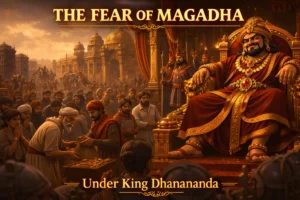
Inside the magnificent palace of Magadha, gold glittered under the torchlight. Ministers stood dressed in silk and jewels. Soldiers guarded every entrance.
The court of King Dhanananda was powerful, wealthy, and feared.
But beneath that wealth, something dangerous had begun to grow.
Arrogance.
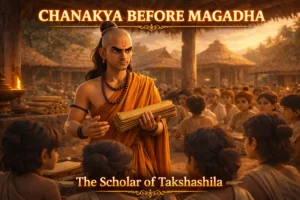
On that day, a man in simple saffron robes walked into the court.
He carried no army.
He carried no weapon.
He carried only knowledge.
That man was Chanakya.
Chanakya Enters the Court of King Dhanananda
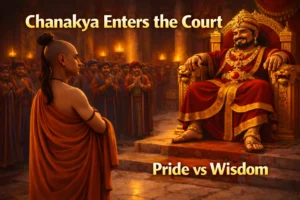
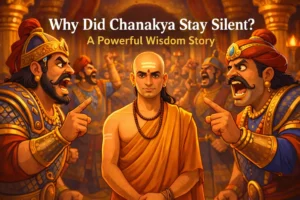
When Chanakya enters the court of King Dhanananda, he does not look like the ministers surrounding the throne.
The courtiers wore gold necklaces and embroidered garments.
Chanakya wore plain robes.
The difference was obvious.
Whispers spread across the hall.
“Who is this scholar?” one minister murmured.
“A wandering teacher,” another replied with a smirk.
But Chanakya did not look at them.
His eyes were fixed on the throne.
King Dhanananda sat comfortably above the court, surrounded by advisers who praised every decision he made.
Power had made him confident.
Too confident.
Chanakya stepped forward calmly.
He bowed respectfully — but not submissively.
“I have come to speak about the welfare of Magadha,” Chanakya said.
The hall grew quiet for a moment.
It was unusual for someone to speak so directly to the king.
Dhanananda leaned forward.
“And who are you,” the king asked coldly, “to advise the ruler of Magadha?”
“I am a teacher,” Chanakya replied.
“And a kingdom survives only when justice guides its power.”
The Day Pride Faced Wisdom
The ministers exchanged amused glances.
A teacher advising a king.
Some began to laugh softly.
But Chanakya continued speaking.
His voice remained steady.
“High taxes are weakening the people,” he said.
“Corruption is spreading among officials. Fear cannot hold a kingdom together forever.”
The court grew uneasy.
Chanakya’s words were not insults.
They were truths.
But truth is dangerous in the presence of pride.
King Dhanananda’s expression darkened.
“You dare to criticize my rule in my own court?” he said sharply.
Chanakya did not step back.
He did not lower his gaze.
“A ruler who listens only to praise,” Chanakya said calmly, “slowly loses the strength of his kingdom.”
The silence that followed felt heavy.
The ministers no longer smiled.
But the king was furious.
Laughter in the Court of Magadha
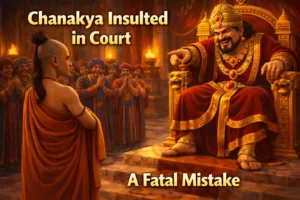
King Dhanananda rose from his golden throne.
His anger echoed through the hall.
“Do you know where you stand?” he shouted.
“This is not a school for wandering teachers!”
The ministers burst into laughter.
Some mocked Chanakya openly.
Others clapped in approval of the king’s anger.
But Chanakya remained still.
The laughter did not shake him.
Because he was not thinking about humiliation.
He was observing the court.
He was studying its weaknesses.
A ruler surrounded by flatterers.
Ministers who feared truth.
A kingdom built on arrogance.
Chanakya understood something important in that moment.
Magadha was powerful.
But it was also vulnerable.
The Beginning of Humiliation
King Dhanananda waved his hand toward the guards.
“Remove this man from my court,” he ordered.
A soldier stepped forward and grabbed Chanakya roughly.
The ministers watched with satisfaction.
To them, the scholar had overstepped his place.
As the guard pushed Chanakya toward the palace exit, his tied hair loosened.
The knot fell apart.
His long hair slipped across his shoulders.
The court laughed again.
It was not respectful laughter.
It was mocking.
Humiliation filled the hall.
But Chanakya did not react.
His face remained calm.
Only his eyes changed.
They were no longer hopeful.
They were calculating.
A Quiet Promise Outside the Palace
When Chanakya reached the palace gates, the guards pushed him outside.
The massive doors closed behind him.
The laughter of the court faded.
The evening sky over Magadha glowed deep orange.
Chanakya stood silently for a moment.
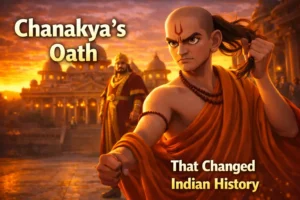
Then he bent down.
Slowly, he gathered his loose hair.
He tied a tight knot in it.
And he spoke quietly.
“I will not untie this knot,” Chanakya said softly, “until I uproot this arrogance from Magadha.”
There was no anger in his voice.
No shouting.
Only determination.
The guards laughed at him.
They did not understand what had just happened.
But history would.
Because that knot was not simply hair tied together.
It was a vow.
The Beginning of a Great Strategy
When Chanakya enters the court of King Dhanananda, he hopes wisdom might guide the king.
When he leaves, he understands something else.
Wisdom alone cannot reform arrogance.
Power must change.
The humiliation in the court does not break him.
It sharpens his purpose.
Chanakya realizes that Magadha needs a different ruler.
A ruler guided by discipline.
A ruler who understands the people.
But such a ruler does not yet exist.
He must be found.
And trained.
Somewhere beyond the palace walls, destiny was preparing someone who could change the future.
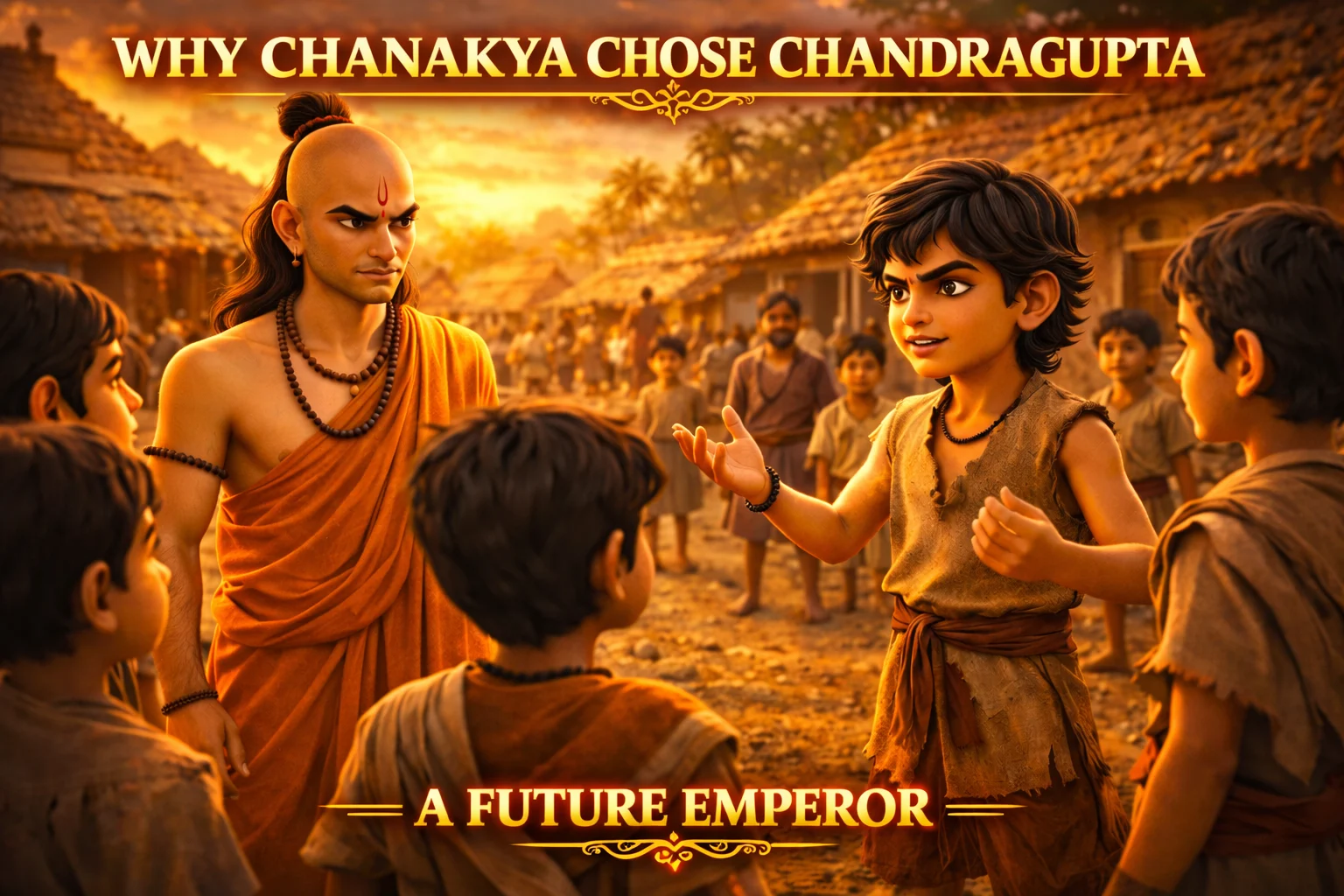
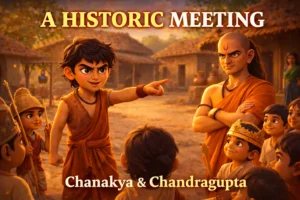
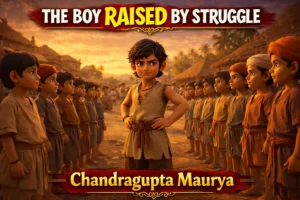
A young boy.
A boy who had grown up facing hardship.
A boy who possessed courage.
His name was Chandragupta.
Chanakya would soon meet him.
And when that happened, the foundations of the Nanda empire would begin to shake.
Why Chanakya Enters the Court of King Dhanananda Matters
Many moments in history seem small at first.
But they become powerful later.
The day Chanakya enters the court of King Dhanananda was not remembered because of the king.
It was remembered because of what happened afterward.
The insult planted a seed.
A seed of strategy.
A seed of revolution.
The ministers laughed that day.
The king felt victorious.
But none of them realized they had created their most dangerous enemy.
A patient strategist.
Chanakya.
And he would not forget the humiliation.
🌟 Moral Reflection
Mockery does not defeat wisdom.
Humiliation does not destroy vision.
Sometimes, the moment you are rejected is the moment your true purpose begins.
✨ Curiosity Ending
The court of Magadha laughed that day.
But Chanakya had already begun planning.
Soon, he would find the boy who could challenge an empire.
His name was Chandragupta Maurya.
And together, they would change Indian histo
❓ Frequently Asked Questions About Chanakya Enters the Court of Dhanananda
1. Why did Chanakya go to the court of King Dhanananda?
Chanakya went to the royal court of King Dhanananda to discuss governance and advise the king about ruling the kingdom of Magadha with wisdom and justice.
2. What happened when Chanakya entered the court of Dhanananda?
When Chanakya entered the court, his appearance and bold ideas were mocked by the king and his ministers, which eventually led to his public humiliation.
3. Why was Chanakya insulted by King Dhanananda?
Chanakya criticized the king’s policies and corruption in the administration, which angered King Dhanananda and resulted in his insult in the royal court.
4. What was the result of Chanakya entering the Magadha court?
The insult that followed Chanakya’s visit eventually led him to vow to destroy the Nanda dynasty and establish a new rule.
5. How did Chanakya’s visit to the court change Indian history?
Chanakya’s humiliation in the Magadha court became the turning point that led to the rise of Chandragupta Maurya and the establishment of the Maurya Empire.
6. Was Chanakya already planning to overthrow the Nanda dynasty?
Most historical traditions suggest that Chanakya decided to overthrow the Nanda dynasty only after his humiliation in the royal court.
📖 Continue the Chanakya Series
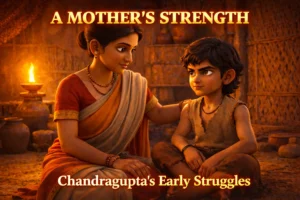
⬅ Part 5: Chandragupta’s Mother and His Early Struggles
➡ Part 7: The Public Insult of Chanakya in Magadha
- The Clever Secret Behind Tenali Raman and the Weight of Ashes (A Brilliant Story of Wisdom)

- Tenali Raman and the Brinjal Curry – A Clever Trick That Silenced the Court
- Tenali Raman Exposed a Liar Without Saying a Word – A Brilliant Courtroom Lesson
- Tenali Raman and the Two Thieves – A Clever Trick That Saved His House
- Tenali Raman and the Horse Trader – A Lesson in Smart Thinking
- The Problem No Scholar Could Solve—Tenali Did It Without a Word
📣 YouTube Channel Subscribe Line
🎥 The animated version of The Ant and the Dove story in English is coming soon!
👉 Subscribe to our YouTube channel for more beautiful moral stories for kids!
🔗 YouTube Channel – A Moral Stories (English)


Post Comment